When your kidneys aren't working right, even something as simple as eating a banana can become dangerous. For people with chronic kidney disease (CKD), high potassium levels - called hyperkalemia - are a silent, life-threatening risk. About 40-50% of those with advanced CKD experience this, and it’s not just about food. It’s about how medications, diet, and emergency care all connect. If your potassium hits 5.5 mmol/L or higher, you’re in danger zone. At 6.0 mmol/L or above, your heart could start misfiring. This isn’t theoretical. People die from this. But it’s also not inevitable.
Why Potassium Gets Out of Control in CKD
Your kidneys normally filter out extra potassium every day. When they’re damaged - especially in stages 3b to 5 - that filter breaks down. Even if you eat the same amount of food you always did, your body starts holding onto potassium. That’s why someone with stage 4 CKD might need to cut potassium intake by half compared to a healthy person.But here’s the catch: the best drugs for protecting your heart and kidneys - like ACE inhibitors, ARBs, and MRAs - make this worse. They’re designed to reduce protein in the urine and slow kidney damage. But they also block the body’s natural way of getting rid of potassium. So doctors face a cruel trade-off: keep the drugs on and risk high potassium, or stop them and risk heart attacks, strokes, or faster kidney failure. Studies show that cutting these drugs because of high potassium increases death risk by over 2 times.
Dietary Limits: What You Can and Can’t Eat
There’s no one-size-fits-all diet. For early CKD (stages 1-3a), you don’t need to go full restriction. Just avoid overdoing it. But if you’re in stage 4 or 5 and not on dialysis, your daily potassium limit is 2,000 to 3,000 mg. That’s less than half what most healthy adults eat.Here’s what that means on your plate:
- One medium banana = 422 mg - skip it
- One cup of orange juice = 496 mg - replace with apple juice
- One medium potato = 421 mg - boil it, then drain the water to cut potassium by 50%
- Avocado = 708 mg per half - avoid completely
- Tomatoes, spinach, beans, and dried fruit = high risk
Some tricks help: leaching vegetables by soaking them in water for 2 hours before cooking cuts potassium significantly. Choose low-potassium alternatives like apples, cabbage, cauliflower, and white rice. A renal dietitian can give you a personalized list. But here’s the hard truth: only 37% of CKD patients stick to their diet long-term. Social events, family meals, and lack of clear guidance make this incredibly tough.

Emergency Treatment: What Happens When Potassium Spikes
If your potassium hits 5.5 mmol/L or higher - especially if you feel weak, have palpitations, or your ECG shows peaked T-waves - you need immediate action. This isn’t a wait-and-see situation.Here’s what happens in the ER:
- Calcium gluconate (10 mL IV) - given over 2-5 minutes. It doesn’t lower potassium, but it protects your heart muscle from the electrical chaos caused by high potassium. Think of it like a safety net while other treatments kick in.
- Insulin + glucose - 10 units of regular insulin with 50 mL of 50% dextrose. This pushes potassium into your cells. Effects start in 15 minutes, peak at 30-60. But watch out: 10-15% of patients get dangerously low blood sugar. That’s why glucose is given with it.
- Sodium bicarbonate - only if you’re also acidotic (bicarbonate <22 mmol/L). Works in 5-10 minutes. It’s not always needed, but when you’re acidotic, it helps.
These are short-term fixes. They buy time. They don’t remove potassium from your body. That’s where binders come in.
Chronic Management: The New Generations of Potassium Binders
For years, the only option was sodium polystyrene sulfonate (SPS), a powder you take by mouth. It had serious problems: it could cause colon damage, and it added a ton of sodium - up to 11 mmol per gram. Many patients couldn’t tolerate it.Now we have two better options:
- Patiromer (Veltassa) - taken once daily. Works in the gut to trap potassium and flush it out. It doesn’t raise sodium or cause colon damage. But it can cause constipation (14% of users) and low magnesium (19%). It also interferes with thyroid meds - if you take levothyroxine, you must space it 3 hours apart.
- Sodium zirconium cyclosilicate (SZC, Lokelma) - taken twice daily. It works faster than patiromer. In just one hour, it can drop potassium by 1.0-1.4 mmol/L. That’s why it’s preferred in emergencies. But it adds sodium - about 1.2 grams per day. That can worsen swelling in heart failure patients.
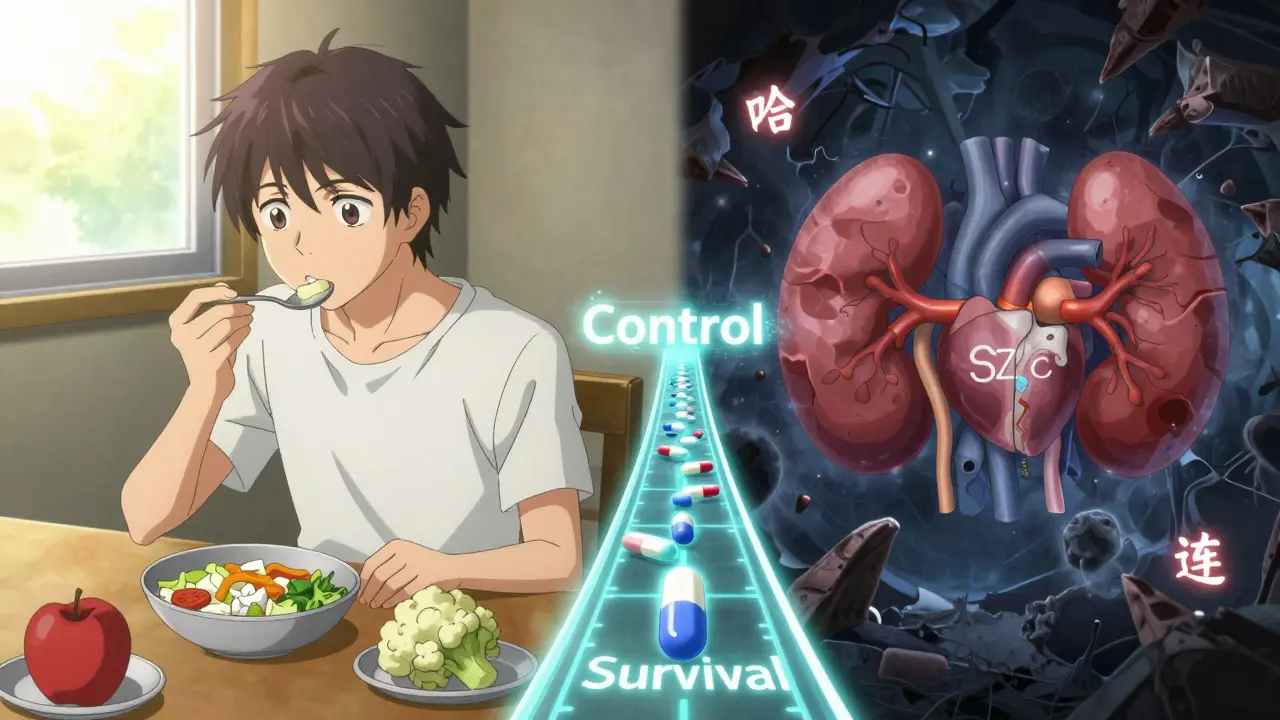
Which one? If you need fast results - say, after a hospital visit - SZC wins. For daily, long-term control without extra sodium? Patiromer. And yes, they cost more. Patiromer runs about $635 a month in the U.S. SPS is $47. But when you factor in ER visits ($12,450 each) and hospital stays, the newer drugs pay for themselves in under two years.
Monitoring and Real-World Challenges
You can’t just treat hyperkalemia once and forget it. You need regular checks. After starting or changing a kidney-protective drug, get your potassium tested within 1-2 weeks. If you’re stable, every 3-6 months is enough. But if you feel off - muscle weakness, irregular heartbeat - get tested immediately.ECG changes are your warning system:
- Peaked T-waves = potassium >5.5 mmol/L
- Widened QRS = potassium >6.5 mmol/L - this is an emergency
- Flat P-waves, sine wave pattern = cardiac arrest risk
Doctors are using tech to help. Some clinics now have EHR alerts that trigger automatic referrals to dietitians when potassium hits 5.0 mmol/L. One study found that using these alerts increased medication adherence from 52% to 81%.
But cost and access are still huge barriers. In community clinics, only 48% of doctors use the newer binders. In academic centers? It’s 82%. Why? Price. Insurance. Lack of training. And many patients can’t afford the $600-a-month drugs.
The Future: Precision and Technology
The next big shift is personalization. Researchers are testing apps that scan food barcodes and instantly tell you how much potassium is in your meal. Early trials show a 32% improvement in diet adherence.Also on the horizon: drugs like tenapanor, which blocks potassium absorption in the gut without being absorbed itself. It’s already approved for phosphate control and may soon be used for potassium.
By 2027, experts predict that 75% of CKD patients on heart-protective drugs will also be on a potassium binder. That’s not a trend - it’s becoming standard care. Because the choice isn’t between high potassium or no medication. It’s between managing potassium - or losing your life.
What is the normal potassium level for someone with CKD?
For most people with CKD not on dialysis, the target is 4.0 to 4.5 mmol/L. This is lower than the general population’s normal range (3.5-5.0 mmol/L) because even mild elevations above 5.0 mmol/L increase heart and kidney risks. Keeping potassium in this narrow range helps protect your heart without forcing you to stop life-saving medications.
Can I still eat fruits and vegetables if I have CKD?
Yes, but you must choose carefully. High-potassium options like bananas, oranges, potatoes, spinach, and tomatoes should be limited or avoided. You can still eat apples, pears, cabbage, cauliflower, and cucumbers. Cooking methods matter: boiling vegetables and discarding the water can cut potassium by up to half. A renal dietitian can give you a safe list tailored to your stage of disease.
Why can’t I just stop my blood pressure meds if my potassium is high?
Stopping your ACE inhibitors, ARBs, or MRAs might lower potassium, but it raises your risk of heart attack, stroke, and faster kidney failure. Studies show that lowering or stopping these drugs increases death risk by 2.1 times in patients with heart failure and CKD. The goal isn’t to stop the meds - it’s to manage potassium so you can keep them.
How do potassium binders work?
They work in your gut. Patiromer and sodium zirconium cyclosilicate bind to potassium in your intestines and trap it so your body can’t absorb it. The bound potassium then leaves your body through stool. Unlike older binders, these don’t cause colon damage and have fewer side effects. They’re not laxatives - they’re targeted potassium traps.
Which potassium binder is better - patiromer or SZC?
It depends. If you need fast results - like after an emergency - SZC works within 1 hour and is preferred. For daily, long-term control, especially if you have heart failure or fluid retention, patiromer is better because it doesn’t add sodium. Patiromer also has fewer GI side effects than older binders, though constipation can still occur. Your doctor will pick based on your health, other conditions, and insurance coverage.
How often should I get my potassium checked?
After starting or changing a kidney-protective medication, check within 1-2 weeks. Once stable, check every 3-6 months. If you’re on a potassium binder, check every 1-2 months initially. If you feel weak, have palpitations, or your heart feels off, get tested immediately - don’t wait for your next appointment.
Are there natural ways to lower potassium?
Diet is the only natural method, but it’s not enough on its own for advanced CKD. You can’t rely on herbs, supplements, or detoxes - they don’t work and can be dangerous. The only proven, safe natural approach is following a low-potassium diet under guidance from a renal dietitian. Everything else - binders, insulin, calcium - requires medical intervention.
Managing hyperkalemia in CKD isn’t about avoiding food or stopping meds. It’s about balancing risk - protecting your heart without letting potassium climb. With today’s tools, you don’t have to choose. You can have both: better kidney and heart health - and control over your potassium.