The Generic Paradox: Low Cost, High Profit
It sounds backward. You walk into a pharmacy, and the brand-name drug costs $150 while the generic version costs $15. Yet, that cheap generic is often what keeps the lights on for the pharmacist behind the counter. This is the core of pharmacy margin economics, which refers to the profit structures within the pharmaceutical supply chain, specifically how pharmacies generate revenue from dispensing medications. In this system, generics are not just cheaper alternatives; they are the primary engine of profitability for most retail pharmacies.
Most people assume that because brand-name drugs have higher price tags, they generate more profit for the pharmacy. The reality is the exact opposite. According to data from the Commonwealth Fund published in August 2021, gross generic margins for pharmacies average 42.7 percent. Compare that to brand-name drugs, which yield a gross margin of just 3.5 percent. While brand drugs account for about 75% of total prescription spending, they contribute a tiny fraction of the pharmacy’s actual income. Generics, representing roughly 90% of all prescriptions dispensed, provide the bulk of the financial cushion pharmacies need to operate.
Where the Money Actually Goes
To understand why margins look this way, you have to look at the entire distribution pipeline. The money flow through the U.S. pharmaceutical system is complex, involving manufacturers, wholesalers, Pharmacy Benefit Managers (PBMs), and finally, the pharmacy. A 2022 analysis by the Schaeffer Center at USC revealed stark differences in who captures value depending on whether the drug is branded or generic.
| Supply Chain Entity | Gross Margin on Brand Drugs | Gross Margin on Generic Drugs |
|---|---|---|
| Manufacturers | 76.3% | 49.8% |
| Pharmacies | 3.5% | 42.7% |
| PBMs | Low (relative) | High (4x brands) |
| Wholesalers | Low | High (11x brands) |
In the branded market, manufacturers capture the lion's share of the value. They make about three times the gross profits on branded drugs compared to generics ($58 vs. $18 per prescription). However, downstream players like pharmacies, PBMs, and wholesalers make substantially more on generic expenditures. Pharmacies make almost twelve times as much on generics as they do on brands-roughly $32 compared to $3 per prescription. This structural imbalance means that when a patient fills a brand-name prescription, the pharmacy is essentially working for free, covering overhead but earning negligible profit.
The Squeeze on Independent Pharmacies
If generics offer such high gross margins, why do so many independent pharmacies struggle? The answer lies in the difference between gross margin and net profit. Gross margin is the percentage of revenue left after subtracting the cost of the drug itself. Net profit is what remains after paying rent, staff salaries, insurance, and technology fees.
The National Association of Chain Drug Stores (NACDS) reported in their 2018 Prescription Drug Pricing document that while about 20% of the average retail prescription price represents the pharmacy's gross margin, the remaining net pharmacy profit after all expenses is only about 2%. For independent pharmacies, the pressure is even greater. The National Community Pharmacists Association (NCPA) reported in their 2022 economic survey that 68% of independent owners identified declining generic drug reimbursement as their top business threat. Average gross margins on generics for independents fell from 24.6% in 2015 to 19.8% in 2022, despite academic research showing higher theoretical markups.
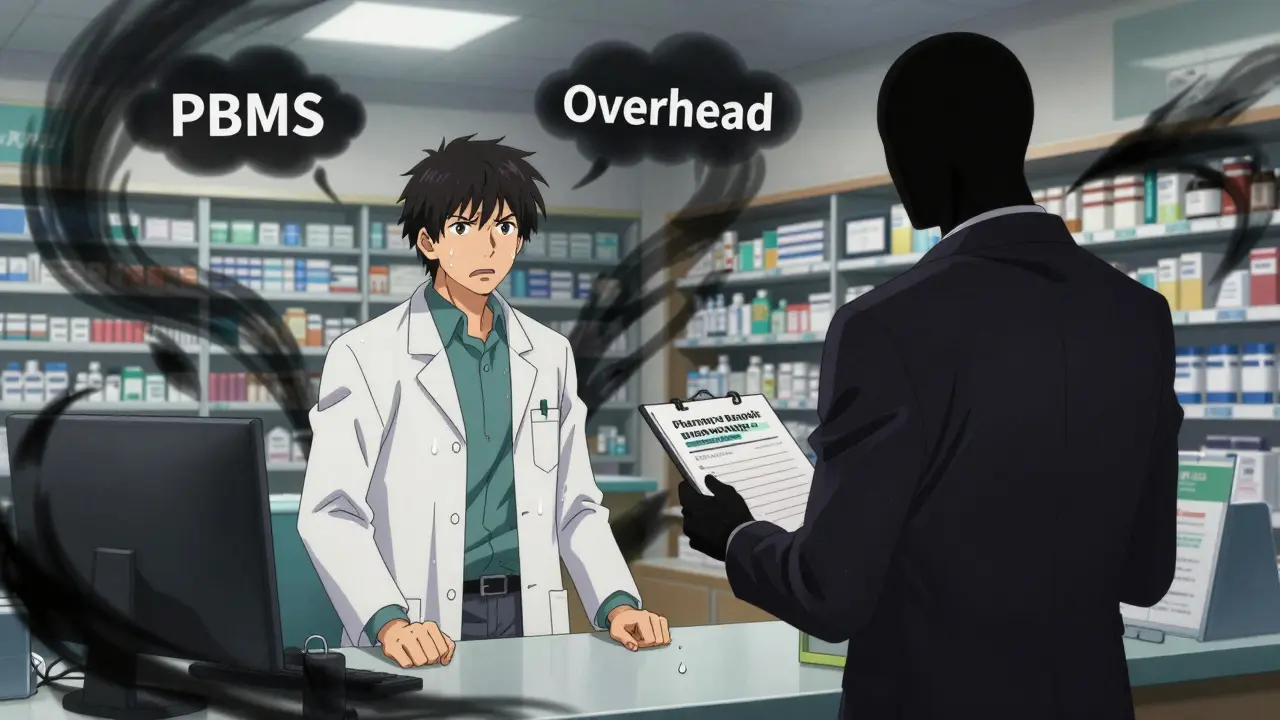
This decline is driven largely by Pharmacy Benefit Managers (PBMs), which are intermediaries that manage prescription drug benefits for health plans, negotiating prices and setting reimbursement rates for pharmacies. PBMs use opaque reimbursement formulas to squeeze pharmacy margins. Common tactics include "spread pricing," where PBMs charge health plans more than they reimburse pharmacies, keeping the difference as profit. Another tactic is "clawbacks," where pharmacies must refund money to PBMs after the fact if they realize they were overpaid. An independent pharmacy owner in Ohio told Pharmacy Times in May 2023, "My net profit on generics has dropped from 8-10% five years ago to barely 2% now, while my overhead has increased 35%." This erosion of profit explains why approximately 3,000 independent pharmacies closed between 2018 and 2023, according to NCPA data.
Channel Disparities: Mail-Order vs. Retail
Not all pharmacies face the same economic reality. The method by which a patient receives their medication significantly impacts the margin structure. Mail-order pharmacies, specialty pharmacies, and large retail chains operate with different leverage and cost structures than local community pharmacies.
A June 2024 analysis by 3Axis Advisors highlighted dramatic disparities in mail-order channels. For generic drugs, average markups in the mail-order channel were more than four times the estimated margins yielded by grocery store pharmacies. For brand drugs, mail-order markups were more than 35 times the margins from small chain and independent pharmacies. Most shockingly, for certain drugs lacking pricing visibility in retail channels, mail-order pharmacies made roughly 1,000 times more margin relative to the underlying drug cost for generic drugs compared to traditional retail settings. This channel disparity creates a competitive environment where scale matters immensely. Large enterprises can absorb lower margins on volume, while independent pharmacies rely on higher per-prescription margins to survive.
Strategies for Survival and Growth
Facing these thin margins, successful pharmacies have had to adapt. Relying solely on dispensing generic pills is no longer a viable long-term strategy for many. Instead, pharmacies are diversifying their revenue streams to bypass traditional PBM relationships and capture more value.
- Medication Therapy Management (MTM): Pharmacists offer clinical services, such as reviewing a patient’s entire medication list to prevent interactions and optimize health. These services are billed separately and often command higher reimbursement rates than simple dispensing.
- Specialty Pharmacy Designations: Specialty pharmacies handle complex, high-cost medications for conditions like cancer or rheumatoid arthritis. These drugs often come with manufacturer support programs and more stable reimbursement structures, providing a buffer against generic margin compression.
- Direct Pay Models: Some pharmacies are shifting to direct contracting with employers or establishing cash-pay models for select medications. By bypassing PBMs, pharmacies can set transparent prices and retain more of the margin. Pharmacies implementing these strategies reported 3-5% higher net margins in a 2023 Pharmaceutical Executive industry analysis.
- Rebuttal Training: To combat unfair rejections, many pharmacies invest in training staff to challenge PBM decisions. The NCPA’s Rebuttal Academy, launched in 2019, has trained over 8,500 pharmacy staff members in challenging PBM reimbursement decisions, helping them recover lost revenue.
Innovative models are also emerging. Mark Cuban’s Cost Plus Drug Company operates on a transparent model, charging the acquisition cost plus a 15% markup and a flat $3 dispensing fee. As of Q2 2024, it was processing 1 million prescriptions monthly, demonstrating consumer demand for transparency. Similarly, Amazon Pharmacy offers clear cost breakdowns, disrupting traditional margin structures. These models highlight an industry recognition of the disconnect between production costs and retail pricing, pushing traditional pharmacies to rethink their economics.
Future Outlook and Regulatory Shifts
The landscape for pharmacy margins is evolving due to regulatory scrutiny and legislative changes. The Federal Trade Commission (FTC) has increasingly scrutinized PBM practices, holding workshops in 2023 specifically examining pharmacy reimbursement. Several states, including California, Texas, and Illinois, passed laws in 2022-2023 requiring greater PBM transparency in reimbursement calculations. Additionally, the Inflation Reduction Act’s Medicare drug price negotiation provisions, effective in 2026, may indirectly affect generic margins by reducing overall drug spending pressure.
However, consolidation remains a significant risk. The top five generic manufacturers controlled 45% of the market in 2023, up from 32% in 2015. This concentration can lead to noncompetitive markets and price spikes, as seen during 2012-2015. Goldman Sachs’ 2023 healthcare report predicted 20-25% more independent pharmacy closures by 2027 without reimbursement reform. Conversely, Leerink Partners projected that pharmacies successfully diversifying into MTM and specialty services could achieve sustainable 4-6% net margins. The future of pharmacy economics will likely favor those who can combine efficient generic dispensing with high-value clinical services and transparent pricing models.
Why do pharmacies make more money on generic drugs than brand-name drugs?
Pharmacies make more money on generics because the gross margin percentage is significantly higher. While brand-name drugs might have a higher dollar price, the pharmacy's markup is often capped at a low percentage (around 3.5%). Generics, though cheaper, allow for a much higher percentage markup (averaging 42.7%), resulting in more absolute profit per prescription for the pharmacy.
What is spread pricing in pharmacy economics?
Spread pricing is a practice used by Pharmacy Benefit Managers (PBMs) where they charge health plans or insurers more for a drug than they reimburse the pharmacy. The PBM keeps the difference as profit. This reduces the amount of money available to the pharmacy, squeezing their margins and contributing to financial instability, especially for independent pharmacies.
How does the Hatch-Waxman Act affect current pharmacy margins?
The Hatch-Waxman Act of 1984 established the modern pathway for generic drug approval, leading to the widespread availability of affordable generics. This created the current margin structure where generics dominate prescription volume (90%) and provide the primary source of profit for pharmacies, while brand-name drugs drive most of the total spending but offer minimal pharmacy profit.
Are independent pharmacies still profitable?
Many independent pharmacies are struggling with profitability due to thin net margins (often around 2%) and increasing overhead. However, those that diversify into specialty pharmacy services, medication therapy management, or direct-pay models can achieve sustainable net margins of 4-6%. Consolidation and PBM pressures continue to threaten their viability, leading to thousands of closures since 2018.
What is the role of PBMs in pharmacy margin economics?
PBMs act as intermediaries between drug manufacturers, health plans, and pharmacies. They negotiate drug prices and set reimbursement rates for pharmacies. Their practices, such as spread pricing and clawbacks, significantly impact pharmacy margins by retaining a portion of the drug cost as profit, often leaving pharmacies with insufficient funds to cover operational expenses.