

When you take a pill, your body doesn't treat it the same way every time. Whether you’ve eaten recently or haven’t eaten in hours can change how much of that drug actually gets into your bloodstream. This isn’t just a minor detail-it’s a core requirement for approving most medications today. The difference between a fasted state and a fed state isn’t just about hunger. It’s about biology, chemistry, and real-world effectiveness.
What Exactly Are Fasted and Fed States?
A fasted state means your body hasn’t processed food for at least 8 to 12 hours. You’ve had water, maybe black coffee, but no calories. Your stomach is empty. Your insulin is low. Your body is tapping into stored fat for energy. This is the condition used in most clinical trials to measure how a drug behaves under "ideal" conditions.
A fed state is the opposite. You’ve eaten a meal-usually a high-fat, high-calorie one-within the last 2 to 4 hours. In pharmaceutical testing, this meal is standardized: around 800-1,000 calories, with 500-600 of those from fat. Your stomach is full, your digestive system is active, your pH levels have dropped, and your blood sugar is rising.
These aren’t just abstract lab conditions. They mirror real life. Some people take pills on an empty stomach. Others take them with breakfast. Both are common. So regulators need to know how the drug behaves in both.
Why the Pharmaceutical Industry Cares
The U.S. Food and Drug Administration (FDA) and the European Medicines Agency (EMA) require dual testing for almost all oral drugs. Why? Because food can make a drug work better-or worse.
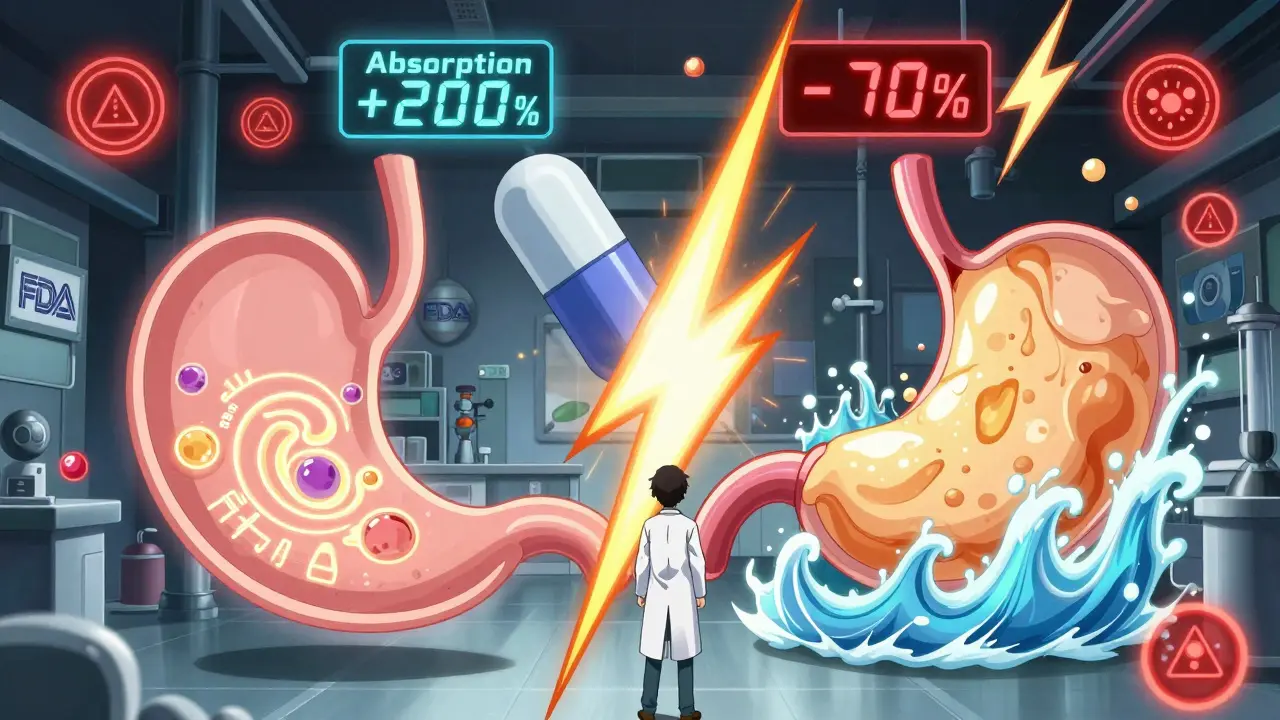
Take fenofibrate, a cholesterol-lowering drug. When taken with food, its absorption increases by 200-300%. Without food, it barely works. On the flip side, griseofulvin, an antifungal, absorbs 50-70% less when taken after a meal. If a drug’s effectiveness changes by more than 20% because of food, regulators demand labeling changes. That means doctors have to tell patients: "Take this on an empty stomach" or "Always take with food."
How do we know this? SmartPill studies show the difference. In a fasted state, the stomach empties in about 14 minutes. In a fed state? It takes over an hour. Gastric pH drops from 2.5 to 1.5. Pressure in the stomach jumps from 30-304 mbar to consistently over 240 mbar. All of this affects how and where the drug dissolves.
Since 2021, the EMA requires fed-state testing for any oral drug where food effects are unknown. A 2019 review of 1,200 new drug applications found that 35% showed clinically meaningful changes in absorption based on food intake. That’s not noise. That’s a pattern. And it’s why the global bioequivalence testing market hit $2.7 billion in 2022-with dual-state testing making up 65% of all protocols.
It’s Not Just About Pills
Exercise scientists have been asking the same question for decades: Does it matter if you train fasted or fed?
Studies show clear differences. In a fasted state, free fatty acids (FFAs) in the blood rise 30-50% higher during moderate exercise. This means your body burns more fat. It also increases PGC-1α expression by 40-50%, a protein linked to mitochondrial growth-essentially training your body to use fat more efficiently over time.
But here’s the catch: you can’t go all-out. Fed-state exercise improves performance by 8.3% during longer workouts (over 60 minutes). Why? Because glycogen stores are higher. Your muscles have more fuel. You can push harder, recover faster. For competitive athletes, that’s the difference between winning and losing.
But for someone trying to lose fat? The science gets messy. A 2021 study in the Journal of the International Society of Sports Nutrition found no difference in body composition after six weeks of fasted vs. fed training-even though fasted sessions burned more fat during the workout. The body adjusts. What matters most over time isn’t the acute fat burn-it’s consistency.
Who Should Train Fasted? Who Should Train Fed?
There’s no universal answer. It depends on your goals.
- If you’re sedentary and want to improve insulin sensitivity, fasted training might help. A 2022 review of 14 trials showed 5-7% better insulin response in people who trained before eating.
- If you’re an endurance athlete, fed-state training gives you a measurable edge. Studies show it improves time to exhaustion by up to 8.3%.
- If you’re doing high-intensity intervals, fasted training can reduce performance by 12-15%. Your body needs glucose to fire at max capacity.
Personalization is the future. A 2022 study found that genetic variants in the PPARGC1A gene explain 33% of why some people respond better to fasted training than others. Your DNA might already be telling you which state works best.

Real-World Confusion
Online communities are split. A 2022 Reddit survey of 1,247 fitness users found 68% felt they had better endurance when fed. Another group, from r/ketogains, found 42% preferred fasted training for fat loss. But 31% of fasted trainers reported dizziness. 22% said they couldn’t lift as heavy.
Professional athletes don’t agree either. Ultramarathoner Scott Jurek swears by fed-state training. CrossFit legend Rich Froning trains fasted to "improve fat-burning efficiency." Both are right-for their goals.
The takeaway? Don’t copy someone else’s routine. Test it yourself. Try a week of fasted workouts. Then a week of fed. Track your energy, your recovery, your performance. Your body will tell you what works.
The Bigger Picture
What’s clear is that the body doesn’t operate in a vacuum. What you eat, when you eat it, and how your system responds are all part of the equation. Whether you’re taking a pill or hitting the gym, the context matters.
Regulators know this. That’s why the FDA now requires fed-state testing across diverse ethnic groups. Research in 2022 showed Asian populations have 18-22% slower gastric emptying than Caucasians in fed conditions. One-size-fits-all dosing doesn’t cut it anymore.
The same is true in fitness. The future isn’t about fasted vs. fed. It’s about personalized timing. Smart wearables now track glucose, heart rate, and recovery in real time. Soon, apps might tell you: "Your body is primed for a fasted workout today."
For now, the rule is simple: if you’re taking medication, follow the label. If you’re training, experiment. But don’t assume one approach is better for everyone. Biology is too complex for that.
Why do some medications need to be taken with food?
Some drugs are lipophilic-they dissolve better in fat. When you eat, your stomach releases bile and enzymes that help absorb these compounds. Medications like fenofibrate or itraconazole can absorb 200-300% more when taken with a high-fat meal. Without food, they may not reach effective levels in your bloodstream.
Can I take my medication on an empty stomach if I feel better that way?
If the label says "take with food," don’t ignore it. Even if you feel fine, your body may not be absorbing the full dose. For drugs with narrow therapeutic windows-like warfarin or cyclosporine-even a 20% drop in absorption can lead to treatment failure or dangerous side effects. Always follow the instructions unless your doctor says otherwise.
Does fasting before exercise help with fat loss?
Fasted exercise increases fat burning during the workout, but studies show no significant difference in long-term fat loss compared to fed-state training. Your total calorie balance over days and weeks matters more than what you burn in a single session. Fasted training may also reduce workout intensity, which can lower total calorie expenditure. For most people, consistency and intensity matter more than fasting.
What’s the standard meal used in fed-state drug testing?
The FDA requires a high-fat, high-calorie meal containing 800-1,000 calories, with 500-600 calories from fat. It typically includes items like eggs, bacon, buttered toast, cheese, and whole milk. This mimics a heavy breakfast and ensures maximum food effect on drug absorption.
Why do some people feel dizzy when exercising fasted?
Fasted exercise lowers blood glucose and can reduce blood pressure, especially if you’re dehydrated or haven’t slept well. Low energy availability means your brain and muscles don’t get enough fuel. This is more common in people with low muscle mass, those on low-carb diets, or anyone skipping meals regularly. If you feel dizzy, stop and eat something light-like a banana or a handful of nuts-before continuing.