

Working the night shift or rotating hours feels like fighting a losing battle against your own body. You know that heavy-eyed feeling at 3 AM when your brain refuses to process information as quickly as it should. For millions of people in healthcare, transportation, and emergency services, this isn't just an inconvenience-it is a safety risk. The good news is that science has found a powerful tool to help you stay sharp without needing eight hours of uninterrupted sleep during your break. That tool is strategic napping.
This isn't about catching random Zs under your desk whenever you feel tired. Strategic napping involves precise timing, duration control, and environmental setup to maximize alertness while minimizing grogginess. When done correctly, these short bursts of rest can improve reaction times by 18% and significantly lower stress hormones, making them one of the most effective ways to manage fatigue in high-stakes jobs.
Why Your Body Struggles on Night Shifts
To understand why strategic napping works, you first need to understand what goes wrong with your biology when you work non-traditional hours. About 15-20% of the global workforce engages in shift work. This disrupts your circadian rhythm, the internal clock that tells your body when to be awake and when to sleep. When you force yourself to stay awake during your natural biological night, your body produces less melatonin (the sleep hormone) and more cortisol (the stress hormone).
This misalignment leads to chronic sleep deprivation. It is not just about feeling tired; it affects your physical health over time. Research shows that shift workers face a 40% increased risk of cardiovascular disease and a 30% higher risk of breast cancer compared to day workers. The immediate danger, however, is cognitive decline. As the night progresses, your ability to sustain attention drops sharply. Without intervention, this leads to errors, accidents, and poor decision-making. Strategic napping acts as a reset button for your nervous system, providing a temporary boost in alertness that helps bridge the gap until your shift ends.
The Science Behind the Perfect Nap
Not all naps are created equal. In fact, a poorly timed nap can make you feel worse than if you hadn't slept at all. The key lies in understanding sleep architecture-the stages your brain cycles through during sleep. There is light sleep (Stage 1 and 2) and deep sleep (Stage 3). You want to wake up from light sleep. If you enter deep sleep and then wake up, you experience sleep inertia, that heavy, disoriented feeling where you cannot think clearly for 15 to 30 minutes.
Research published in Frontiers in Sleep Medicine (2024) confirms that a nap duration of 20 to 30 minutes provides the optimal balance. This window allows you to enter light sleep and gain restorative benefits without diving into deep sleep stages. Studies show that when nap duration is controlled to under 30 minutes, sleep inertia occurs in less than 5% of cases. During these strategic naps, 43% of workers achieve beneficial light sleep, leading to measurable improvements in performance metrics.
Timing is equally critical. Your circadian trough-the time when your body naturally wants to sleep the most-usually hits between 2:00 AM and 4:00 AM. Taking a nap during this window yields the highest return on investment. Nurses participating in CDC studies reported a 7.3 out of 10 helpfulness rating for naps taken between 1:00 AM and 3:00 AM. Waking up after this period aligns better with your body's rising alertness curve as morning approaches.
Napping vs. Other Fatigue Strategies
You might wonder if coffee or other methods could replace the need for a nap. While caffeine is popular, it is not as effective for sustained attention during long shifts. A study by Caldwell et al. (2009) compared a 200mg dose of caffeine to strategic napping during the final two hours of a 12-hour night shift. The results were clear: strategic napping provided 32% greater improvement in sustained attention tasks than caffeine alone. Caffeine blocks adenosine (the chemical that makes you feel sleepy), but it does not remove it. Sleep actually clears adenosine from your brain.
Another strategy is "sleep banking," which involves sleeping extra hours before a shift starts. While helpful for overall recovery, research by Petrie, Powell, & Broadbent (2004) shows it is 19% less effective than strategic napping for reducing end-of-shift fatigue. Sleep banking prepares you for the start of the shift, but it cannot prevent the inevitable crash that happens in the early morning hours. Light therapy is another option, helping your body adjust to new schedules, but it takes 3 to 5 days of consistent use to show acute performance benefits. Strategic napping works immediately, within the same shift.
| Strategy | Time to Effectiveness | Impact on Alertness | Primary Limitation |
|---|---|---|---|
| Strategic Napping | Immediate (during shift) | High (32% better than caffeine) | Requires quiet space and policy support |
| Caffeine (200mg) | 15-30 minutes | Moderate | Wears off; causes jitters/anxiety |
| Sleep Banking | Pre-shift preparation | Low-Moderate (19% less effective than napping) | Does not address mid-shift crashes |
| Light Therapy | 3-5 days of consistent use | High (long-term adaptation) | No immediate effect on acute fatigue |
How to Set Up Your Nap Environment
Your environment dictates whether you fall asleep quickly and wake up refreshed. Trying to nap in a noisy break room with bright fluorescent lights often fails because your brain remains in a state of hyper-vigilance. To reduce sleep onset latency (the time it takes to fall asleep) by 37%, you need to mimic nighttime conditions.
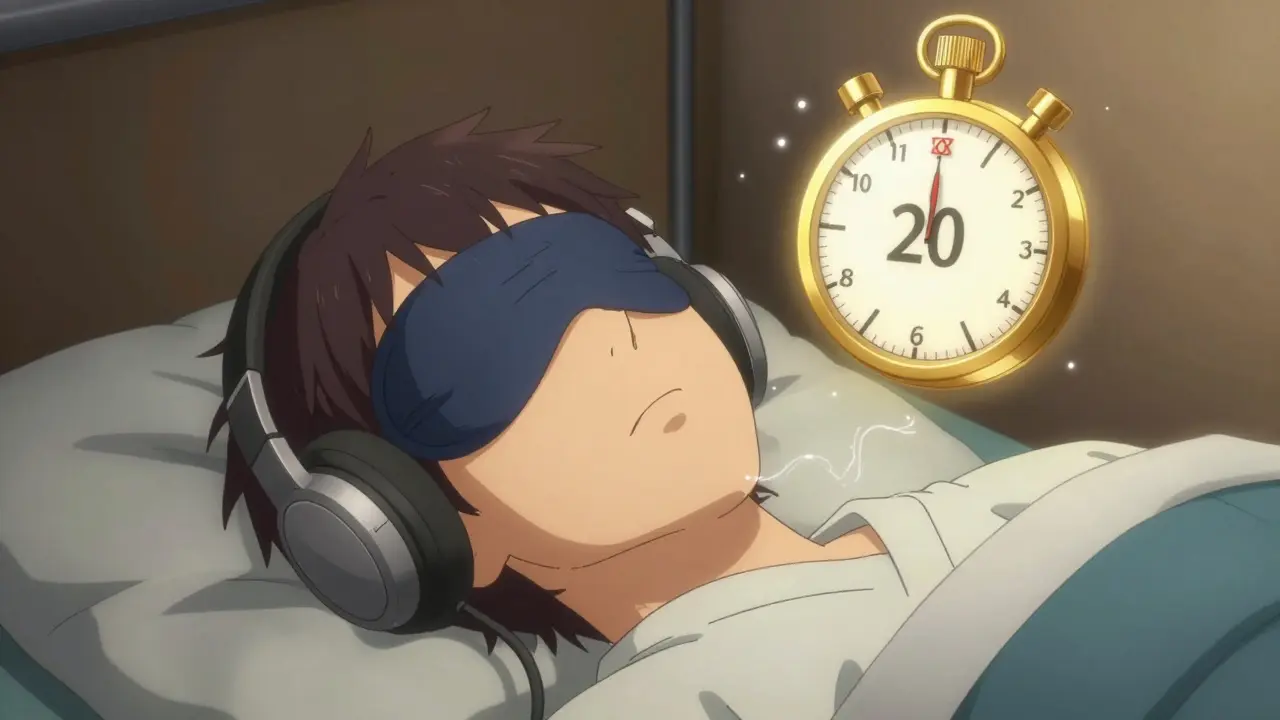
If your workplace offers a dedicated nap room, use it. These rooms should be soundproofed, temperature-controlled (cooler temperatures promote sleep), and equipped with dimmable lighting. If you do not have access to a special room, you must create your own sanctuary. Use noise-canceling headphones or earplugs to block out alarms and conversations. An eye mask is essential to block light, which signals your brain to stay awake. Some workers find success using a travel pillow and a blanket to create a physical barrier from the surrounding activity.
Dr. Nancy Redeker from Yale University emphasizes that strategic napping is the single most effective acute intervention for reducing performance deficits. However, she notes that the environment must support relaxation. If you are anxious about being watched or interrupted, your cortisol levels will remain high, negating the benefits of the rest. Advocacy for proper facilities is part of the process.
Overcoming Workplace Barriers
Even with the best personal habits, organizational culture can hinder strategic napping. Implementation barriers are significant. A survey by Geiger-Brown & McPhaul (2011) found that 83% of nurse managers cite staffing shortages as the primary obstacle to allowing naps. There is a fear that taking staff off the floor, even for 20 minutes, compromises patient care or operational efficiency.
Additionally, there is a stigma attached to resting. Ruggiero & Avi-Itzhak (2011) reported that 67% of night-shift nurses feel stigmatized for napping, viewing it as laziness rather than a professional safety measure. This cultural hurdle is real. However, data proves otherwise. In a unit where 20-minute power naps were implemented at 3 AM, medication errors dropped by 37% in six months. Emergency medical technicians reported 29% fewer near-miss driving incidents when permitted to take strategic naps.
To overcome these barriers, frame napping as a safety protocol, not a perk. Share the economic analysis showing a $2.30 return per $1 invested in napping programs due to reduced errors. Advocate for scheduled nap periods rather than on-demand breaks. Scheduling ensures coverage is maintained while giving everyone a guaranteed window to rest. The Joint Commission’s 2011 Sentinel Event Alert identified lack of napping opportunities as a contributing factor in 12% of nursing errors, providing a strong regulatory argument for change.

Practical Steps for Immediate Implementation
If you are ready to try strategic napping tonight, here is a step-by-step guide to maximize its effectiveness:
- Set a Timer: This is non-negotiable. Set an alarm for 20 to 30 minutes. Do not guess. Oversleeping leads to sleep inertia.
- Choose the Right Time: Aim for the window between 2:00 AM and 4:00 AM. This aligns with your circadian trough.
- Prepare the Space: Put on an eye mask and earplugs. Dim the lights if possible. Lie down in a reclined position if a bed is not available.
- Use a Coffee Nap (Optional): Drink a small cup of coffee right before you lie down. Caffeine takes about 20 minutes to kick in. You will wake up just as the caffeine starts working, combining the benefits of rest and stimulation.
- Wake Up Brightly: When the alarm goes off, get up immediately. Expose yourself to bright light if possible. This helps signal your brain that the rest period is over and boosts alertness further.
- Track Your Results: Use the Karolinska Sleepiness Scale to rate your alertness before and after. Look for a reduction of at least 2 points on the 9-point scale to confirm efficacy.
The Future of Shift Work Safety
The landscape of shift work is changing. Regulatory bodies are beginning to recognize strategic napping as a standard of care. OSHA’s 2024 draft guidelines include strategic napping as a "best practice intervention" for fatigue management in healthcare. California’s 2022 Fatigue Risk Management Act already requires strategic napping options for 12-hour shift workers in certain sectors. The European Union’s Working Time Directive mandates rest facilities for night workers, driving higher adoption rates in Europe compared to the US.
Technology is also evolving to support this practice. Pilot studies with wearable technology show a 27% improvement in nap efficacy when biometric data guides personalized nap timing. Instead of guessing when you are tired, wearables can detect micro-sleeps or heart rate variability changes to suggest the perfect moment to close your eyes. By 2030, 78% of occupational health experts predict that strategic napping will become standard practice in all high-risk shift work industries.
For now, the power is in your hands. By understanding the physiology of sleep and advocating for smart rest periods, you can protect your health, improve your performance, and ensure the safety of those who rely on you during the night hours.
How long should a strategic nap be for shift workers?
A strategic nap should last between 20 and 30 minutes. This duration allows you to enter light sleep stages which restore alertness, while avoiding deep sleep stages that cause sleep inertia (grogginess) upon waking. Naps longer than 30 minutes increase the risk of entering deep sleep, making it harder to return to work effectively.
What is the best time to take a nap during a night shift?
The optimal time for a strategic nap is between 2:00 AM and 4:00 AM. This period coincides with the circadian trough, when your body's natural drive for sleep is strongest. Napping during this window yields the greatest improvement in alertness and performance metrics compared to earlier or later times in the shift.
Is strategic napping better than drinking coffee?
Yes, for sustained attention during long shifts, strategic napping is more effective. Research shows that a 20-30 minute nap provides 32% greater improvement in attention tasks than a 200mg dose of caffeine alone. However, combining both methods-a "coffee nap" where you drink caffeine right before a 20-minute nap-can provide synergistic benefits as the caffeine kicks in just as you wake up.
What is sleep inertia and how do I avoid it?
Sleep inertia is the groggy, disoriented feeling experienced immediately after waking from deep sleep. To avoid it, keep your naps under 30 minutes. This prevents your brain from entering Stage 3 deep sleep. Additionally, waking up to bright light and moving around immediately can help dissipate any residual drowsiness.
Can my employer require me to take naps?
While employers cannot typically force an individual to sleep, many organizations, especially in aviation and healthcare, are implementing mandatory rest periods or structured nap policies to enhance safety. Regulations like the EU Working Time Directive and emerging US laws encourage or mandate access to rest facilities. It is best to check your specific industry regulations and company policies.