
When you're diagnosed with glaucoma, your doctor doesn't just hand you a prescription and hope for the best. They're making a decision that could affect your vision for the rest of your life. Two of the most common first-line treatments are prostaglandins and beta blockers. Both lower eye pressure - the main driver of glaucoma damage - but they do it in completely different ways, and they come with very different risks and side effects.
How Prostaglandins Work - And Why They're First Choice
Prostaglandin analogs, like latanoprost, bimatoprost, and travoprost, are the most prescribed glaucoma medications today. They work by opening up a natural drainage pathway in the eye called the uveoscleral outflow. Think of it like clearing a clogged drain in your sink. Instead of forcing more fluid in, they help the fluid that's already there flow out more easily. This reduces pressure inside the eye - called intraocular pressure (IOP) - by 24% to 33% on average.
They're taken just once a day, usually at night. That convenience matters. A 2019 study in the Journal of Managed Care & Pharmacy found that 39% of patients were still using their prostaglandin medication after a year. Only 25% of beta-blocker users stuck with theirs. Why? Fewer side effects, no need to remember a second dose, and better IOP control.
But they're not perfect. The most common side effect is redness in the eye - up to half of users notice it. It's not dangerous, but it can be embarrassing. More concerning are the long-term changes: eyelashes get longer and darker, and in 5% to 10% of people, the iris (the colored part of the eye) darkens permanently. This is more common in people with hazel or green eyes. Once it happens, it doesn't go away. Some patients stop using the medication because of this, even though it's not harmful.
Not all prostaglandins are the same. Bimatoprost lowers pressure slightly more than latanoprost - maybe by 1 to 2 mmHg - but it also causes more burning and stinging. About 25% to 30% of bimatoprost users report irritation, compared to 15% to 20% with latanoprost. That’s why many doctors start with latanoprost. If it doesn't work well enough, they switch.
Beta Blockers - Effective, But With Hidden Risks
Beta blockers like timolol and betaxolol work differently. They don’t help fluid drain. They cut down on how much fluid the eye makes in the first place. They’re effective, lowering IOP by about 20% to 25%. But they’re taken twice a day, and that’s where problems start.
The bigger issue? They get absorbed into your bloodstream. That’s fine for most people - until it isn’t. If you have asthma, COPD, or a slow heart rate, beta blockers can make things worse. They can trigger bronchospasm, cause fatigue, or even lead to heart failure in vulnerable patients. That’s why the FDA requires a black box warning on these drugs - the strongest safety alert they can issue.
Even if you’re healthy now, your health can change. A 65-year-old patient might be fine on timolol for years. Then they develop a heart rhythm issue. Suddenly, that eye drop becomes a risk. That’s why doctors screen carefully before prescribing them.
There’s another layer: preservatives. Most eye drops contain benzalkonium chloride (BAK), a chemical that keeps the bottle sterile. But over time, BAK damages the surface of the eye. A 2021 meta-analysis in Acta Ophthalmologica showed that patients on preservative-free beta blockers had better tear film stability and less dryness. The catch? The difference in eye pressure reduction between preserved and preservative-free versions was tiny - just 0.29 mmHg. So if your eyes feel dry or irritated, switching to a preservative-free version might improve comfort without hurting your eye pressure control.
Combining Them - Does It Really Help?
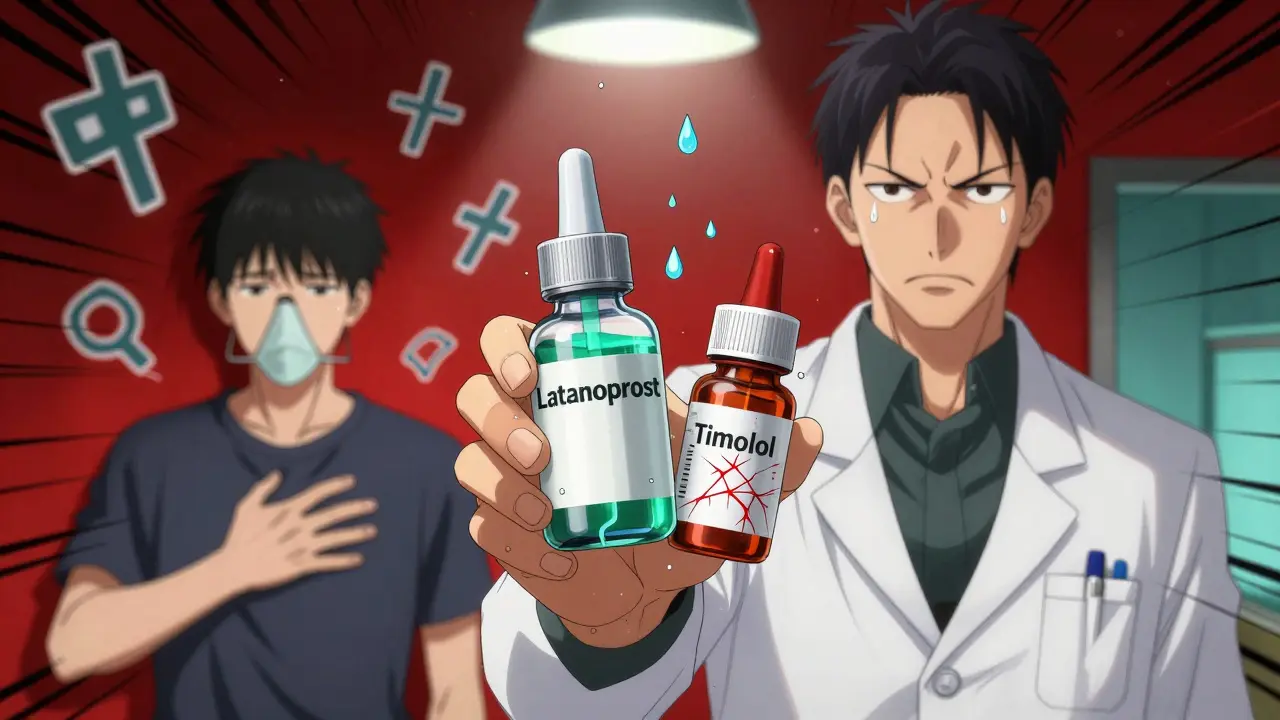
Many patients need more than one medication. That’s where combining a prostaglandin and a beta blocker comes in. When you use latanoprost and timolol together, they lower pressure by 13% to 25% more than either drug alone. That’s powerful.
That’s why fixed-dose combinations exist - like Simbrinza (brinzolamide + brimonidine) or Combigan (timolol + brimonidine). But here’s the twist: putting a prostaglandin and a beta blocker in the same bottle doesn’t always improve outcomes. A 2005 study in Glaucoma Today found no clear advantage over using them separately. And mixing two prostaglandins - like bimatoprost and latanoprost - can actually raise eye pressure in some people. That’s a dangerous mistake, and it’s not recommended.
Still, combination therapy is common. Why? Because adherence drops sharply when patients have to use three or four different bottles. One drop twice a day is easier than two drops three times a day. So doctors often prescribe a fixed combo - even if the evidence for its superiority is weak.
Safety First - Who Should Avoid What?
Choosing the right medication isn’t just about what works best. It’s about what’s safest for you.
- If you have asthma or COPD, avoid beta blockers entirely. Even low doses can cause breathing trouble.
- If you have heart failure, slow heart rate, or low blood pressure, beta blockers can be risky.
- If you’re young, active, and care about appearance, prostaglandins might not be ideal - eyelash growth and iris darkening are permanent.
- If you’re on other medications that affect your heart or lungs, your pharmacist and doctor need to check for interactions.
There’s also a hidden risk: preservatives. Long-term use of preserved drops can damage the cornea. That’s why some clinics now offer preservative-free options for patients on chronic therapy. They cost more - about 20% to 25% higher - but for someone using drops for 10, 20, or 30 years, it might be worth it.
What the Long-Term Data Shows
A seven-year study published in the Journal of Clinical & Experimental Ophthalmology in 2013 followed over 1,200 glaucoma patients. It found something surprising: there was no meaningful difference in vision loss between people taking prostaglandins and those on beta blockers. Both groups had similar rates of visual field decline. That’s huge. It means neither drug is “better” at saving your sight - at least not in the long run.
What does make a difference? Adherence. The patient who takes their latanoprost every night, even when their eye looks fine, is far more likely to keep their vision than the one who skips doses because of redness or forgetfulness. That’s why convenience matters more than theoretical potency.
Another insight from that study: visual fields often improve slightly in the first six months, then stabilize. That’s not a cure - it’s the treatment working. If your vision seems better early on, don’t assume you’re cured. Keep taking the drops.
What’s Next? The Future of Glaucoma Treatment
While prostaglandins and beta blockers are still the backbone of treatment, new options are emerging. Minimally invasive glaucoma surgeries (MIGS) are becoming more common, especially for patients who need to reduce pills. But they’re not replacements - they’re helpers. Most people still need medication.
Researchers are now working on new prostaglandin formulations that don’t cause redness or darkening. Sustained-release implants are being tested too - tiny devices that deliver medication for months at a time. But for now, the choice remains simple: prostaglandins for most, beta blockers only when necessary.
The bottom line? Glaucoma isn’t about finding the strongest drug. It’s about finding the one you can live with - safely - for decades. Your doctor’s job isn’t just to lower your pressure. It’s to help you stay on treatment without making your life harder.
Can prostaglandins really change the color of my eyes?
Yes. Prostaglandin analogs like latanoprost, bimatoprost, and travoprost can cause permanent darkening of the iris, especially in people with hazel, green, or light brown eyes. This happens in about 5% to 10% of long-term users. It’s not harmful, but it’s irreversible. If you’re concerned about appearance, talk to your doctor before starting treatment.
Are beta blockers safe if I have asthma?
No. Beta blockers like timolol can trigger severe bronchospasm in people with asthma or COPD. Even eye drops can be absorbed into the bloodstream and cause breathing problems. If you have any lung condition, your doctor should avoid prescribing them. Alternative medications like prostaglandins or carbonic anhydrase inhibitors are safer options.
Why do some glaucoma drops have preservatives?
Preservatives like benzalkonium chloride (BAK) prevent bacterial growth in multi-dose bottles, making them cheaper and easier to use. But over time, BAK can damage the surface of your eye, leading to dryness, irritation, and even corneal damage. Preservative-free versions exist and are better for long-term users - especially those on multiple medications - but they cost more and come in single-use vials.
Can I use two different prostaglandins together?
No. Using two prostaglandins together - like bimatoprost and latanoprost - can actually raise eye pressure in some patients. This is not recommended, even though they work through the same pathway. Stick to one prostaglandin at a time. If one isn’t enough, add a different class of medication, like a beta blocker or a carbonic anhydrase inhibitor.
How long does it take to see results from glaucoma drops?
You won’t feel the drops working - glaucoma doesn’t cause pain. But eye pressure usually drops within a few hours, and the full effect is seen after about two weeks. The real benefit, though, is long-term: keeping pressure low for years to prevent vision loss. Don’t stop taking them just because you don’t notice changes.