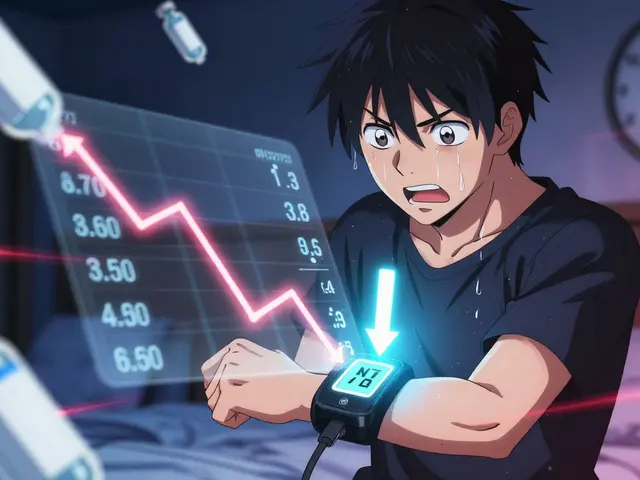

CGM Trend Arrow Dose Calculator
Insulin Adjustment Calculator
Calculate precise insulin adjustments based on CGM trend arrows and your personal correction factor. Follows Endocrine Society guidelines for adults and children.
How to Use This Tool
1. Select your current trend arrow from the dropdown
2. Enter your correction factor (1:50 means 1 unit lowers glucose by 50 mg/dL)
3. Choose your age group for the appropriate adjustment
4. Enter your insulin-on-board (IOB) value
5. Click "Calculate Adjustment" to see your recommended dose
6. Always verify with a fingerstick reading if you're unsure
Most people with diabetes think of Continuous Glucose Monitoring (CGM) as a tool that just shows numbers - like a fancy blood sugar meter that updates every five minutes. But if you’re still using your CGM only to react to high or low readings, you’re missing half the power it offers. The real game-changer isn’t the number on the screen. It’s the trend arrow pointing up, down, or flat beside it. That little symbol tells you where your glucose is heading in the next 15 to 30 minutes. And when you pair that with your insulin or other diabetes medications, you can stop chasing highs and lows - you can prevent them.
Why Trend Arrows Matter More Than Single Numbers
A glucose reading of 130 mg/dL might seem fine. But if the arrow is pointing sharply down, you’re heading for a low in 20 minutes. If it’s pointing up, you’re about to spike - even if you just took insulin. Traditional blood glucose meters give you a snapshot. CGM gives you a video. And that video shows you the direction, speed, and momentum of your glucose.
The Endocrine Society published clear, evidence-based guidelines in 2017 that turned trend arrows into actionable dosing rules. These aren’t suggestions. They’re protocols backed by clinical trials showing patients who used them had 28% fewer hypoglycemic events and spent 17% more time in target range (70-180 mg/dL). The key insight? Don’t treat the number. Treat the trend.
How to Use Trend Arrows for Insulin Adjustments
CGM systems like Dexcom G5, G6, and G7 show eight types of trend arrows: two double-up (fast rising), one single-up (rising), one flat (stable), one single-down (falling), and two double-down (fast falling). Each tells you how fast your glucose is changing - measured in mg/dL per minute.
Adjusting insulin based on these arrows requires knowing your personal correction factor - how much one unit of insulin lowers your glucose. For example, if your correction factor is 1:50, one unit drops your glucose by 50 mg/dL. The guidelines give exact unit adjustments based on this, not vague percentages.
For adults with a 1:50 correction factor:
- Double-up arrow: Add 1.2 units to your pre-meal or correction dose
- Single-up arrow: Add 0.8 units
- Flat arrow: No adjustment
- Single-down arrow: Subtract 0.8 units
- Double-down arrow: Subtract 1.2 units
For children and teens, the adjustments are smaller: +1.0, +0.6, 0, -0.6, -1.0 units respectively. These numbers were designed to reduce guesswork. No more thinking, "Should I increase by 15% or 20%?" Just follow the table.
What About Non-Insulin Medications?
Most people assume these rules only apply to insulin. But the 2024 ADA/EASD consensus report now recommends applying trend arrow insights to other drugs too. Take SGLT2 inhibitors - drugs like dapagliflozin or empagliflozin. These work by flushing glucose out through urine. They’re great for lowering blood sugar, but they can also cause euglycemic ketoacidosis - a dangerous condition where your body burns fat for fuel even though your glucose looks normal.
If your CGM shows consistent glucose levels under 180 mg/dL with ketones above 0.6 mmol/L (check with a blood ketone meter), your provider may recommend reducing your SGLT2 inhibitor dose. Trend arrows help here too: if your glucose is flat or slowly rising while ketones climb, you’re in a risk zone. The CGM doesn’t measure ketones, but it shows you the pattern that should trigger a test.
Common Mistakes and How to Avoid Them
Many people jump into trend arrow adjustments and make things worse. Here are the top three mistakes:
- Overcorrecting for falling trends - You see a double-down arrow, so you cut your insulin. But you forgot you took insulin 90 minutes ago. That insulin is still active. You end up with a 45 mg/dL low. Always check your insulin-on-board (IOB) before adjusting.
- Ignoring sensor lag - During rapid changes (like after a meal or exercise), CGM sensors can be 5-15 minutes behind your real blood glucose. If your arrow is flat but you just ate, don’t assume you’re stable. Wait 10 minutes.
- Adjusting during sensor warm-up - New sensors take 2 hours to calibrate. Don’t trust arrows in the first 2 hours. Stick to your old dosing rules until the sensor is fully validated.
A 2019 case series in Diabetes Care found that 12% of new CGM users increased their hypoglycemia risk by over-correcting. That’s why the American Association of Diabetes Educators recommends 15-20 minutes of focused education during CGM setup. You need to understand your insulin’s peak time, how your body responds to food, and how your CGM behaves under stress.
Real Stories: What Works and What Goes Wrong
On the r/typeonegriit subreddit, one user named "InsulinWizard42" reduced their weekly lows from 3.2 to 0.7 after using the Endocrine Society tables. "It took the guesswork out of dosing," they wrote. "When my sugar was trending up before meals, I knew exactly how much extra insulin to give. No more panic."
But another user on Diabetes Daily wrote: "I doubled my insulin for a double-up arrow without checking my IOB. I woke up at 42 mg/dL." That’s the danger of applying rules without context.
A 2021 survey by Beyond Type 1 found that 68% of CGM users use trend arrows for dosing. Of those, 82% reported better time-in-range. The other 32% didn’t use them - mostly because they were afraid of making a mistake (47%) or never got proper training (39%).

Technology Is Catching Up
The FDA cleared the first CGM-integrated dose adjustment app - DAFNE+ - in May 2023. It automatically calculates the right adjustment using Dexcom G6 data. In clinical trials, it cut user error by 62%. That’s huge. But it still requires you to know your correction factor and IOB. The app doesn’t replace knowledge - it reinforces it.
Verily’s Onduo platform is testing AI that predicts trends 45 minutes ahead, not just 15. In a 2022 NEJM pilot, it reduced hypoglycemia by 38%. These tools are coming fast. But they’re built on the same foundation: trend arrows + personal insulin sensitivity + context.
What You Need to Do Right Now
If you’re on insulin or other diabetes meds and using a CGM:
- Find your correction factor. Ask your provider if you don’t know it.
- Download the Endocrine Society adjustment tables (Dexcom’s provider portal has printable versions).
- Track your insulin-on-board for 3 days. Use your pump or app to see how long your insulin lasts.
- For 7 days, pause your usual corrections. Instead, use only the trend arrow rules. Record your glucose before and after each adjustment.
- After a week, compare your time-in-range. You’ll likely see improvement.
And if your provider hasn’t taught you this - ask them. The ADA’s 2023 Standards of Care say all insulin-treated patients should receive this education within 30 days of starting CGM. You have a right to it.
Future of CGM Dosing
By 2026, 75% of diabetes educators are expected to be trained in trend arrow dosing, up from just 44% today. The CDC’s National Diabetes Prevention Program is adding modules for this. Manufacturers are pushing for standardized arrows - Dexcom and Abbott still use different thresholds for "fast" trends. That’s changing. And hybrid closed-loop systems are now using trend data to auto-adjust basal rates in real time.
The goal isn’t to eliminate human judgment. It’s to make judgment smarter. Your CGM isn’t just a monitor. It’s a predictive tool. And when you use it right, you don’t just manage diabetes - you get ahead of it.
Can I use trend arrows if I’m not on insulin?
Yes - but differently. If you’re on SGLT2 inhibitors (like Jardiance or Farxiga), trend arrows can help you spot euglycemic ketosis - where glucose looks normal but your body is burning fat. If your glucose is flat or slowly rising with ketones above 0.6 mmol/L, your provider may reduce your dose. For GLP-1 agonists (like Ozempic), trend arrows help identify delayed lows after meals. The principle is the same: use the trend to prevent problems before they happen.
Do all CGMs have the same trend arrows?
Not exactly. Dexcom uses double arrows for rates above 2 mg/dL per minute. Abbott’s FreeStyle Libre uses them for above 3 mg/dL per minute. That means the same glucose movement might show as "single-up" on one device and "double-up" on another. Always check your device’s manual. The Endocrine Society guidelines are being updated in 2024 to include all major CGMs, but for now, use the rules that match your device’s definition.
What if my CGM says my glucose is falling, but I feel fine?
Trust the trend, but verify. CGMs can lag, especially during rapid changes. If you feel fine and your arrow is single-down, wait 10 minutes. Check your glucose with a fingerstick. If the fingerstick matches the CGM, then yes - reduce your insulin. If it doesn’t, your sensor might be off. Never adjust based on a sensor reading during warm-up, after a signal loss, or if the device says "calibrating."
Can I use this method at night?
Absolutely - and it’s especially valuable at night. A double-down arrow while you’re asleep could mean a dangerous low. The pediatric guidelines were designed with nighttime safety in mind. If your child’s glucose is falling fast at 2 a.m., reducing their basal insulin or delaying a snack can prevent a seizure. Parents who use this method report fewer nighttime emergencies. Always pair this with a reliable alarm system.
How long does it take to see results?
Most people see improvements in time-in-range within 7-14 days. A study in Diabetes Technology & Therapeutics showed significant gains in just 10 days. The biggest wins are fewer lows and less anxiety. You’ll know you’re doing it right when you stop checking your glucose every 20 minutes - because you’re no longer surprised by where it’s going.