When a brand-name drug loses its patent, you’d expect a flood of cheap generics to hit the market. But sometimes, the same company that made the original drug starts selling its own version under a generic label. That’s an authorized generic-and it’s changing how drug prices work.
What exactly is an authorized generic?
An authorized generic isn’t a copy made by a rival company. It’s the exact same drug, made by the original brand-name manufacturer, but sold without the brand name. Think of it like Coca-Cola selling a version of its soda labeled just "Cola"-same formula, different packaging. The FDA has been tracking these since 1999, and they’re listed separately from traditional generics that file Abbreviated New Drug Applications (ANDAs).
Why does this matter? Because authorized generics let the original company stay in the game after patent expiry. Instead of losing all revenue to competitors, they drop the price slightly and keep shelf space, pharmacy contracts, and patient loyalty. It’s not charity-it’s strategy.
How did authorized generics become a thing?
The whole system started with the Hatch-Waxman Act of 1984. That law created the modern generic drug market by letting companies copy brand-name drugs faster and cheaper. But it also gave brand manufacturers a loophole: they could launch their own generic version before competitors did. By the 2010s, this became common. Between 2010 and 2019, there were 854 authorized generic launches, with the highest number in 2014.
Here’s the twist: most authorized generics didn’t launch right after the patent expired. Three out of four waited until after the first traditional generic entered the market. Why? Because if the brand drops its price too early, it risks cannibalizing its own sales. So companies timed their moves carefully-often waiting for a rival to take the first hit, then swooping in with a slightly cheaper version of their own.
Why do oral tablets dominate this market?
Not all drugs are equal when it comes to authorized generics. The data shows a clear pattern: over 70% of authorized generics are oral solids-tablets and capsules. Why? Because these are easier and cheaper to replicate. The chemistry is stable, the manufacturing process is well-understood, and getting FDA approval is faster than for injectables or biologics.
That’s why you’ll see authorized generics for drugs like atorvastatin (Lipitor), omeprazole (Prilosec), or metformin. These are high-volume, high-revenue drugs that face fierce competition. The brand manufacturer doesn’t want to lose control. So they launch their own generic version, often with the same packaging, same label, same lot numbers-just without the flashy brand name.
What’s changing in the market?
For years, brand manufacturers used authorized generics as a weapon: delay the launch, let the first generic take the fall, then undercut them. But that tactic is fading. According to RAPS in June 2025, the practice of delaying authorized generic launches is declining. Why? Two reasons: regulatory pressure and shifting market logic.
Regulators are watching closer. Policymakers now see authorized generics as a way to extend monopoly pricing under a different name. A 2025 JAMA Health Forum study found that delaying generic competition for just three years after patent expiry cost commercial insurers $2.5 billion and Medicare $2.4 billion-mostly from drugs like imatinib and celecoxib. That’s not just a business tactic-it’s a cost to patients.
At the same time, the market is getting bigger. The U.S. generic drug market is projected to hit $196.9 billion by 2034. Between 2025 and 2030, drugs making $217 billion to $236 billion in annual sales will lose exclusivity. That’s a lot of money up for grabs. Brand manufacturers can’t afford to sit back anymore. They need to move fast.
The FDA’s new pilot program
In October 2025, the FDA announced a major shift: a pilot program to fast-track ANDA reviews for drugs made and tested entirely in the U.S. This isn’t just about speed-it’s about supply chain control. After years of relying on overseas manufacturing, especially for active ingredients, the U.S. government is pushing for domestic production.
What does this mean for authorized generics? A lot. If a brand manufacturer wants to launch an authorized generic, they now have an incentive to make it in America. Faster approval, less risk, better public perception. This could push more authorized generics toward U.S.-based production, especially for high-demand drugs like insulin or asthma inhalers.
It also blurs the line between traditional generics and authorized ones. If both types are competing for the same fast-track approval, the advantage of being the original maker might shrink. That could lead to more competition, not less.
Biosimilars are coming-and they’re different
While authorized generics have mostly focused on pills, the next wave is coming from biologics. Drugs like ustekinumab and vedolizumab, which treat autoimmune diseases, will lose patent protection starting in 2025. These aren’t simple molecules. They’re complex proteins. That means traditional generics won’t work. Enter biosimilars.
Unlike authorized generics, biosimilars aren’t exact copies. They’re highly similar, but not identical. And they’re not made by the original brand company. So far, biosimilars have saved $20.2 billion in 2024 alone, and $56.2 billion since 2015. The opportunity for oncology and immunology biosimilars alone could hit $25 billion by 2029.
Will brand manufacturers try to launch "authorized biosimilars"? Not likely. The science doesn’t allow it. But they might try to partner with biosimilar makers or buy them outright. The strategy is shifting from control to collaboration.
Who wins and who loses?
Patients are the biggest winners when prices drop. Generic drugs saved the U.S. healthcare system $467 billion in 2024. But authorized generics don’t always lead to the lowest price. Sometimes, they just keep the original company in charge while pretending to be competitive.
Traditional generic manufacturers lose out when a brand manufacturer launches its own generic. They can’t compete with a company that already owns the manufacturing line, the regulatory filings, and the distribution network.
But if the FDA’s new pilot program encourages more domestic production, and if delays in authorized generic launches keep falling, then the market could become more transparent. More competition. Lower prices. Fewer tricks.
What’s next?
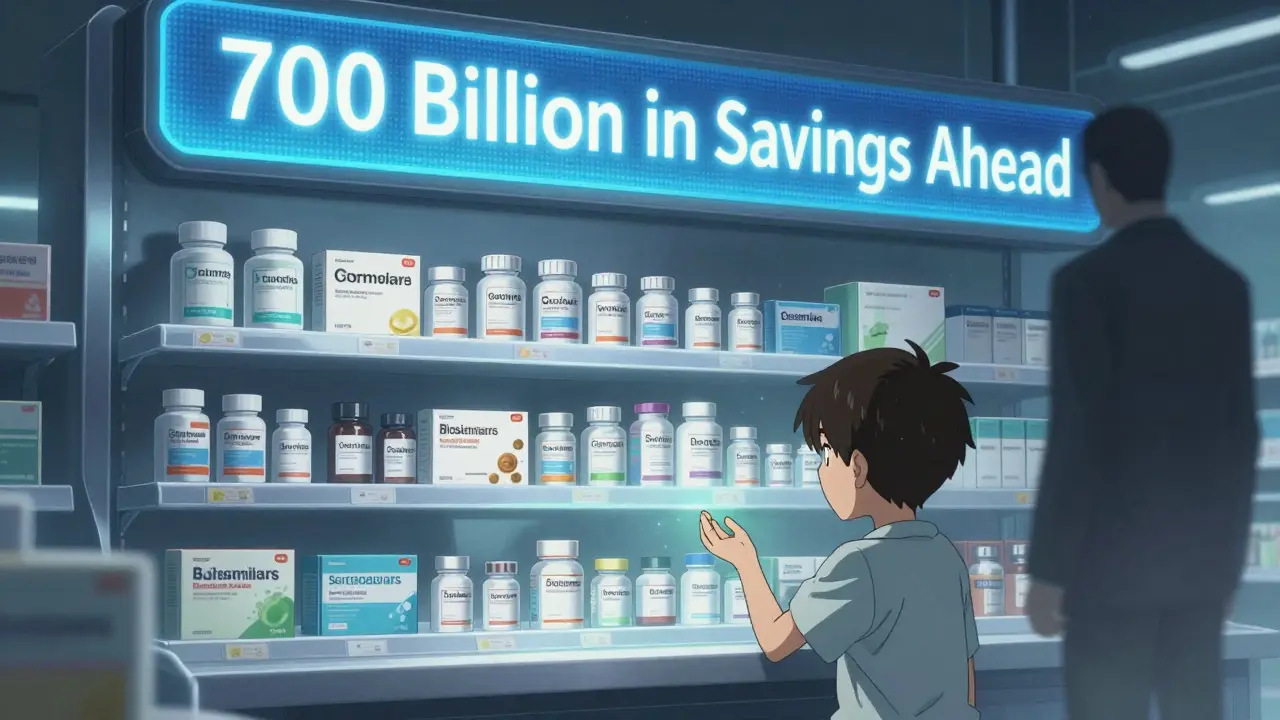
The future of authorized generics isn’t about hiding from competition anymore. It’s about adapting to it. With over $700 billion in global generic drug sales expected by the early 2030s, and hundreds of billions in patents expiring, the game is changing.
Brand manufacturers won’t disappear from the generic market. But they’ll have to play by new rules: faster approvals, domestic production, and less delay. The days of sitting on an authorized generic to squeeze out competitors are ending.
For patients, that’s good news. For the system, it’s a chance to get real savings. And for regulators? It’s a chance to finally close the loophole that let brands pretend they were being fair.