
When you’re pregnant, every decision feels bigger. What you eat, what you take, even what you breathe - it all matters. And when it comes to vaccines, the questions pile up: Are they safe? When should I get them? Will they protect my baby? The answers aren’t complicated, but they’re often buried under fear, outdated myths, or silence from providers. The truth is simple: certain vaccines during pregnancy aren’t just safe - they’re one of the most powerful tools you have to protect both yourself and your newborn.
Why Vaccines During Pregnancy Matter
Your immune system changes during pregnancy. You’re not sick, but your body holds back some defenses to keep your baby from being seen as a threat. That makes you more vulnerable to infections like the flu, whooping cough, and COVID-19. These aren’t just colds. They can lead to preterm birth, hospitalization, or worse.
But here’s the real win: when you get vaccinated while pregnant, your body makes antibodies - and they cross the placenta. That means your baby gets protection before they’re even born. Newborns can’t get most vaccines until they’re two months old. Until then, they’re defenseless. Your vaccine becomes their first shield.
Studies show that antibodies from maternal vaccines transfer at ratios between 0.62 and 0.82. That’s not perfect, but it’s enough to cut the risk of severe illness in babies by half or more. For whooping cough, that means avoiding ICU stays. For flu, it means skipping the hospital. For RSV, it means breathing easier during those first dangerous months.
The Vaccines You Need (and When)
Not all vaccines are created equal during pregnancy. Only specific ones are recommended - and timing matters more than you think.
- Influenza (flu) vaccine: Get it as soon as it’s available, usually in late summer or early fall. You can get it any time during pregnancy, but the goal is to be protected by the time flu season peaks (December to February). In the 2020-21 season, 43.2% of pregnant people in England got the flu shot - and those who did were 60-70% less likely to catch the flu. The vaccine is inactivated, so it can’t cause the flu. Side effects? Mild soreness, maybe a headache. That’s it.
- Tdap (tetanus, diphtheria, pertussis): This one has a narrow window: between 27 and 36 weeks. The sweet spot? 27 to 30 weeks. That’s when your body makes the most antibodies, and they have the best chance to cross over. If you get it too early - before 20 weeks - your baby gets 37% fewer protective antibodies. In 2020-21, 67.1% of pregnant people in England got Tdap. In the U.S., coverage jumped from 14.4% in 2012 to 60.3% in 2022. Why? Because it works. Babies born to vaccinated moms are 78% less likely to get whooping cough in their first two months.
- COVID-19 mRNA vaccines (Pfizer or Moderna): These are safe at any point during pregnancy. In fact, unvaccinated pregnant people were 96% more likely to be hospitalized with severe COVID-19 between May and October 2021. The effectiveness against infection? 89.2%. Against hospitalization? 96.3%. The CDC tracked over 139,000 pregnant people who got the vaccine. 84.6% had no pregnancy complications. The most common side effect? Pain at the injection site - reported by nearly 70%.
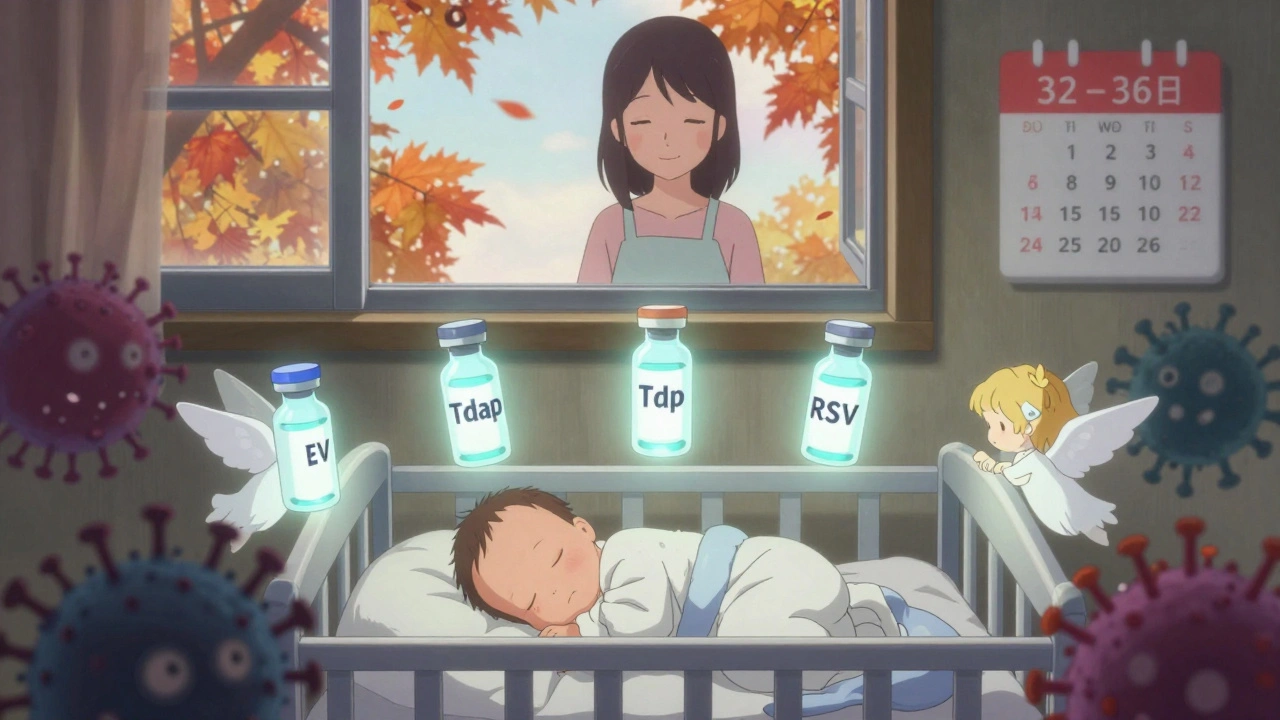
- RSV vaccine (Abrysvo): Approved in May 2023 and recommended by September 2023, this is a game-changer. You get it between 32 and 36 weeks, during September through January. It cuts the risk of your baby needing medical care for RSV by 81.8% in the first 90 days of life. In a survey of over 3,200 parents, 92% reported no side effects after getting it. Only 8.7% had mild fatigue or headache - and it lasted less than two days.
Vaccines to Avoid During Pregnancy
Not all vaccines are okay. Live vaccines - those made with weakened viruses - are off-limits. Why? Because there’s a tiny theoretical risk the virus could affect the baby, even though no cases have ever been proven.
- MMR (measles, mumps, rubella)
- Varicella (chickenpox)
- Nasal flu spray (LAIV)
If you need any of these, get them at least 28 days before you get pregnant. If you’re already pregnant and you accidentally got one? Don’t panic. There’s no evidence of harm, but you should tell your provider so they can monitor things. The CDC has tracked thousands of these cases - no pattern of birth defects or complications has ever shown up.
What About Breastfeeding?
Good news: you can get all the recommended vaccines while breastfeeding. In fact, you should. Your body keeps making antibodies, and they pass through breast milk. It’s not as strong as placental transfer, but it helps. The flu shot, Tdap, and COVID-19 vaccines are all safe while nursing. The RSV vaccine? You can get it before delivery, and it still protects your baby after birth. No need to wait.
Even live vaccines like MMR are fine while breastfeeding. The virus doesn’t pass through milk. So if you missed a vaccine before pregnancy, you can catch up after delivery - no waiting.
How Safe Are These Vaccines, Really?
People worry about ingredients. Thimerosal? Formaldehyde? Aluminum? These are in tiny, safe amounts - far less than what your body handles naturally every day. The flu vaccine has been given to over 1.2 million pregnant people since 2010. Tdap to over 1.5 million. No safety signals. No increased risk of miscarriage, preterm birth, or birth defects.
The CDC’s Vaccine Safety Datalink reviewed 39,055 pregnancies where Tdap was given during pregnancy. Nothing unusual. The FDA’s Pregnancy and Lactation Labeling Rule now requires all new vaccines to include real human data on pregnancy outcomes. That didn’t exist 10 years ago. Now it’s standard.
And the numbers speak for themselves. A 2023 review of 147 studies involving 2.3 million pregnancies found that the benefits of recommended vaccines always outweigh the theoretical risks. That’s not opinion. That’s science.
Why Some People Still Hesitate
Even with all this data, hesitation lingers. A March of Dimes survey found that 41.2% of vaccine-hesitant pregnant people feared something would harm their baby. That fear isn’t silly - it’s protective. But it’s based on old stories, not facts.
On Reddit, one mom wrote: “I got Tdap at 28 weeks. My arm hurt for a day. My baby was born healthy. No one talked to me about it until I asked.” That’s the problem. Too often, providers assume you know - or they don’t bring it up at all. But since January 2023, ACOG has required doctors to document vaccine counseling in prenatal records. That’s pushed recommendation rates from 76% to over 93%.
Don’t wait for them to ask. Bring it up. Say: “I want to make sure I’m getting the right vaccines at the right time.” If they don’t know, they can look it up. You’re not being pushy - you’re being smart.
What Happens After You Get Vaccinated?
Most people feel fine. A sore arm. A little fatigue. Maybe a low-grade fever. That’s your immune system doing its job. It’s not the vaccine making you sick - it’s your body learning to fight.
Severe reactions? Extremely rare. Anaphylaxis happens in about 1 in a million doses. That’s why providers watch you for 15 minutes after the shot. If you have a history of severe allergies, tell them ahead of time.
Side effects are logged in VAERS - the Vaccine Adverse Event Reporting System. For Tdap, it’s 0.8 reports per 10,000 doses. For flu, it’s 1.2. Compare that to the 1 in 200 risk of hospitalization from flu during pregnancy - and the numbers don’t even come close.
What’s Next? The Future of Pregnancy Vaccines
The science is moving fast. A Group B Strep vaccine (GBS6) is in Phase III trials as of late 2023. Early data shows it boosts protective antibodies 13 to 23 times. GBS is a leading cause of newborn sepsis. If this works, it could be routine by 2027.
Another big one? A universal flu vaccine. Current shots change every year because the flu mutates. The new mRNA-1010 candidate, entering Phase III trials in December 2023, promises 85% effectiveness across multiple strains - not just the few predicted each season.
The WHO wants 70% global coverage of pregnancy vaccines by 2030. Right now, it’s 45-60% in rich countries and 15-25% in poorer ones. That gap isn’t just unfair - it’s deadly. Every dollar spent on maternal Tdap saves $2.70 in infant hospital costs. That’s not charity. That’s smart economics.
What You Should Do Now
Check your calendar. If you’re pregnant:
- Get the flu shot if it’s between July and January.
- If you’re 27-36 weeks, get Tdap - and make sure it’s the adult version, not the childhood one.
- If you’re 32-36 weeks and it’s September through January, ask about the RSV vaccine.
- If you haven’t had a COVID-19 vaccine since 2023, ask if you need the latest monovalent version.
If you’re planning pregnancy, check your vaccine record. Missing MMR or varicella? Get them now - and wait 28 days before trying to conceive.
If you’re breastfeeding? You’re still protected. Keep up with your own shots. You’re still your baby’s best defense.
There’s no perfect time to be a parent. But you can give your baby a head start - one shot at a time.