You walk into the pharmacy, and the pharmacist asks a simple question: "Do you want the generic or the brand?" It feels like a test. You’ve heard generics are cheaper, but are they actually as good? The short answer is yes. In fact, generic drugs are required by law to be identical to their brand-name counterparts in every way that matters for your health-except for the price tag.
The confusion isn't just about money; it's about trust. Many people still cling to the belief that "you get what you pay for," even when science says otherwise. This guide cuts through the noise. We’ll look at exactly how much you save, why the prices differ so drastically, and whether there are any rare cases where sticking with the brand might make sense.
Why Are Generic Drugs So Much Cheaper?
To understand the price gap, you have to look at who pays for the research. When a pharmaceutical company develops a new brand-name drug, it spends billions of dollars and years conducting clinical trials to prove safety and efficacy before the FDA approves it. Those costs don't vanish after approval; they need to be recouped. That’s why brand drugs carry high price tags-they’re funding the next generation of medicines.
Generic manufacturers, on the other hand, don’t repeat those expensive trials. Thanks to the Hatch-Waxman Act (passed in 1984), generic companies can use an Abbreviated New Drug Application (ANDA). They simply have to prove their version is bioequivalent to the original. This means the generic delivers the same active ingredient, in the same amount, over the same timeframe. No multi-year studies. No billion-dollar R&D bills. Just manufacturing and distribution costs.
The result is a massive price difference. According to the Association for Accessible Medicines (AAM) 2025 report, Americans spent $700 billion on just 435 million brand prescriptions, while spending only $98 billion on 3.9 billion generic prescriptions. Generics account for 90% of all prescriptions filled but only 12% of total spending. That is not a rounding error; that is a structural advantage built into the system.
Bioequivalence: What It Actually Means for You
If you’re worried that the generic is a "watered-down" version, here is the technical reality. The FDA requires generic drugs to meet strict standards of quality, strength, purity, and stability. But the most critical metric is bioequivalence.
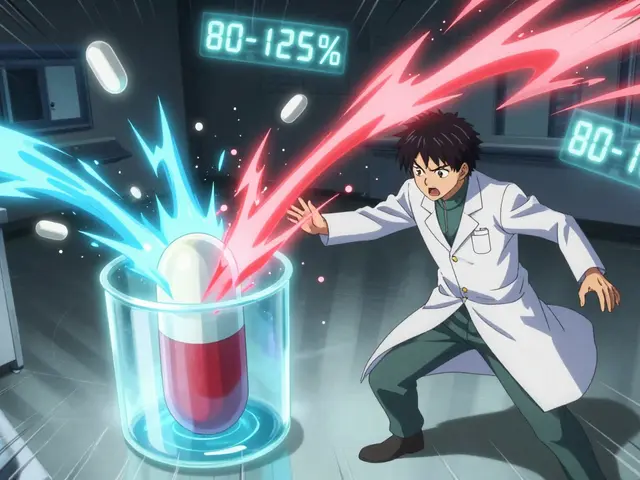
This doesn’t mean the drug is 100% identical molecule-for-molecule in terms of inactive ingredients (like dyes or binders), which can sometimes cause minor differences in appearance or taste. Instead, it means the drug performs identically inside your body. The pharmacokinetic parameters-the rate and extent of absorption-must fall within 80-125% of the brand-name product’s performance. For most medications, this range ensures therapeutic equivalence. Your body processes the generic exactly as it would the brand.
In a January 2025 survey by Tebra involving over 1,000 Americans, 84% of respondents believed generics were "just as effective." Yet, 62% still trusted brand names more. This psychological gap persists despite the data. If the FDA didn’t enforce these rigorous bioequivalence standards, insurers wouldn’t mandate generic substitution, and the healthcare system would collapse under the weight of unnecessary costs.

The Real Cost Savings: By the Numbers
Let’s talk dollars. How much do you actually save? The FDA estimates that generic drugs cost 79-85% less than their brand-name equivalents. Tebra’s 2025 consumer survey corroborated this, finding generics cost approximately 79% less on average.
| Metric | Brand Name Drugs | Generic Drugs |
|---|---|---|
| Average Price Reduction | Baseline | 79-85% lower |
| Prescription Volume Share | ~10% | ~90% |
| Total Spending Share (US) | ~88% | ~12% |
| Regulatory Pathway | New Drug Application (NDA) | Abbreviated New Drug Application (ANDA) |
| Primary Cost Driver | R&D and Clinical Trials | Manufacturing and Distribution |
Consider a common scenario: a prescription for cholesterol medication. A brand-name statin might cost $300 a month. The generic equivalent often costs less than $15. Over a year, that’s a savings of nearly $3,400 per patient. Multiply that by millions of patients, and you see why the U.S. healthcare system relies so heavily on generics. Since 2019, total spending on generic sales in the U.S. has actually declined by $6.4 billion, even as the volume of prescriptions increased. Generics are the only sector consistently driving down healthcare costs.
When Might You Need the Brand Name?
Are there exceptions? Yes, but they are rare. Most doctors and pharmacists will tell you to stick with the generic unless specific conditions apply. Here are the few scenarios where a brand-name drug might be necessary:
- Narrow Therapeutic Index (NTI) Drugs: These are medications where a tiny change in blood concentration can lead to serious side effects or treatment failure. Examples include warfarin (blood thinner), levothyroxine (thyroid hormone), and certain anti-seizure medications. While generics exist for these, some patients may experience sensitivity to slight variations in inactive ingredients between manufacturers. In these cases, staying with one specific manufacturer (whether brand or generic) is crucial.
- Patient Sensitivity to Inactive Ingredients: Generics must contain the same active ingredient, but they can use different fillers, dyes, or binders. If you have a severe allergy to lactose, gluten, or a specific dye used in a generic formulation, you might need the brand name or a different generic manufacturer.
- Insurance Formulary Restrictions: Sometimes, insurance plans require prior authorization for generics due to shortages, or conversely, they may restrict brand names entirely without a documented medical necessity. Check your plan’s formulary.
For the vast majority of medications-antibiotics, blood pressure meds, antidepressants, pain relievers-the generic is the smarter choice. The American Medical Association and the FDA both support using generics whenever appropriate.
How Competition Drives Prices Down
The price of a generic drug isn’t static; it depends on competition. The Assistant Secretary for Planning and Evaluation (ASPE) at the Department of Health and Human Services found a clear pattern: more competitors mean lower prices.
- One Competitor: Prices typically fall to about 90% of the pre-generic brand price. The savings are modest because the first generic maker has a monopoly on the low-cost option.
- Three to Four Competitors: Prices drop significantly to 60-70% of the original brand price. This is where the real savings kick in.
- Five or More Competitors: Prices plummet below 50% of the pre-generic level. In highly competitive markets, generics can cost pennies on the dollar compared to the brand.
This dynamic explains why some brand-name drugs lower their own prices preemptively. In 2025, Bayer reduced the list price of Nexavar by 50% after its generic version launched in 2022. Merck cut prices on Januvia by over 40%, likely anticipating Medicare price negotiations mandated by the Inflation Reduction Act. Manufacturers know that once multiple generics enter the market, their revenue share evaporates quickly.
Navigating Your Pharmacy Bill
So, how do you ensure you’re getting the generic price? First, ask your doctor to write "dispense as written" only if you truly need the brand. Otherwise, leave it open for substitution. Second, check with your pharmacist. They often have access to preferred generic brands that offer the lowest copay.
Don’t forget about mail-order pharmacies and discount cards. For uninsured patients, services like GoodRx can reveal stark differences in cash prices between local pharmacies. A generic might be $5 at one chain and $20 at another. Always shop around.
With the Medicare Part D redesign capping out-of-pocket costs at $2,000 annually starting in 2025, the financial incentive to choose generics remains strong. Even with caps, reducing your monthly spend helps manage overall healthcare budgets. Remember, the U.S. public-sector prescription net prices are 18% lower than peer countries largely because of this robust generic market. You are benefiting from a system designed to balance innovation funding with accessible care.
Are generic drugs really as effective as brand names?
Yes. The FDA requires generic drugs to demonstrate bioequivalence, meaning they deliver the same active ingredient in the same amount and timeframe as the brand-name drug. Studies show they perform identically in the body for the vast majority of patients.
Why are generic drugs cheaper?
Generic manufacturers don't pay for the initial costly clinical trials and research development that brand-name companies do. They only need to prove their drug is bioequivalent, saving billions in R&D costs which translates to lower prices for consumers.
Can I switch between different generic manufacturers?
For most drugs, yes. However, for Narrow Therapeutic Index (NTI) drugs like thyroid medication or blood thinners, it is best to stay with the same manufacturer to avoid minor variations in inactive ingredients that could affect sensitive patients.
Does insurance cover generics better?
Almost always. Insurance plans incentivize generic use by offering lower copays. Some plans may even require prior authorization for brand-name drugs if a generic alternative exists, ensuring you pay the least possible amount.
What is bioequivalence?
Bioequivalence is a regulatory standard requiring that a generic drug absorbs into the bloodstream at a similar rate and extent as the brand-name drug. The pharmacokinetic parameters must be within 80-125% of the brand, ensuring therapeutic equivalence.