Antipsychotic QT Prolongation Risk Calculator
Patient & Medication Profile
Additional Risk Factors:
Risk Assessment Result
Enter patient details and click calculate to see the estimated risk profile.
Imagine this scenario: A patient with severe schizophrenia needs medication to stabilize their condition. The psychiatrist prescribes a standard antipsychotic. Two weeks later, the patient collapses due to Torsade de Pointes, a life-threatening heart rhythm disorder. This isn't just a theoretical nightmare; it's a documented risk when certain psychiatric drugs interact with the heart's electrical system. The culprit? QT Prolongation, an abnormality where the heart takes longer than usual to recharge between beats. You might wonder how common this is or if you should avoid these medications entirely. The truth is more nuanced. While nearly all antipsychotics carry some risk of affecting the QT interval, the degree varies wildly-from negligible changes to dangerous spikes. Understanding which drugs pose the greatest threat, how they interact with other cardiac medications, and what monitoring steps protect patients is critical for both clinicians and caregivers. This guide breaks down the science, the statistics, and the practical steps needed to manage this intersection of psychiatry and cardiology safely.
Understanding the Mechanism: Why Antipsychotics Affect the Heart
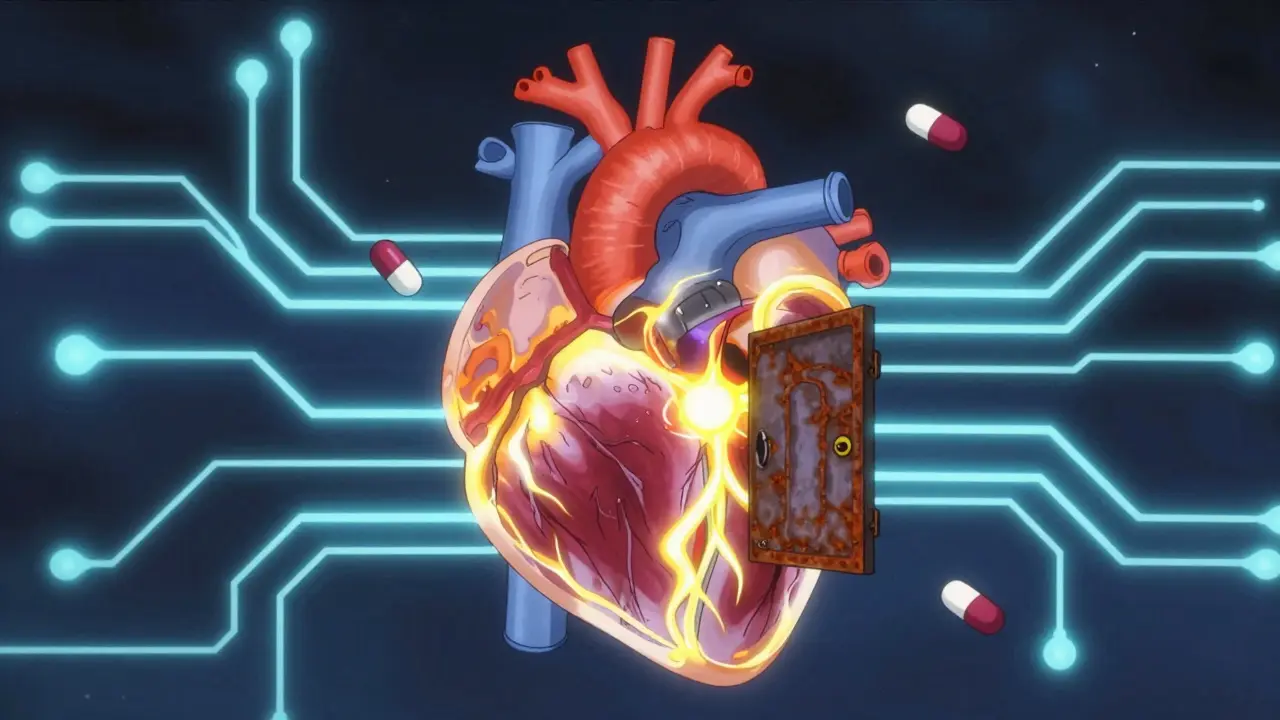
To grasp the risk, we first need to understand what the QT interval represents. On an electrocardiogram (ECG), the QT interval measures the time it takes for the ventricles (the heart's lower chambers) to depolarize and repolarize-essentially, the time from the start of a heartbeat to its completion. When this interval is prolonged, the heart muscle stays electrically active longer than normal. If the QTc (corrected QT interval) exceeds 500 milliseconds, the risk of developing Torsade de Pointes increases significantly. This arrhythmia can cause fainting, seizures, or sudden cardiac death if not treated immediately. Antipsychotic medications, particularly those that block potassium channels in the heart, are known to delay this repolarization process. Think of it like a door that sticks shut; the heart has to work harder and take longer to reset for the next beat. First-generation antipsychotics, such as thioridazine and haloperidol, have been linked to this effect since the 1960s. However, modern second-generation agents also carry varying degrees of risk, making it impossible to ignore this factor in treatment planning.
Risk Profiles: Which Antipsychotics Are Safest?
Not all antipsychotics are created equal when it comes to cardiac safety. Research published in Psychopharmacology (2023) analyzed FDA Adverse Event Reporting System data from 2004 to 2021, revealing a clear hierarchy of risk based on Reporting Odds Ratios (ROR). Here is how the major players stack up:
- High Risk: Thioridazine (ROR 14.2) causes approximately 35 ms of QTc prolongation. Due to these severe risks, it was removed from the U.S. market in 2005. Haloperidol (ROR 5.8) remains widely used but requires strict monitoring, especially in IV form.
- Moderate Risk: Ziprasidone (ROR 4.9) shows about 10-15 ms of prolongation at therapeutic doses. While some ICU studies suggest minimal risk in healthy hearts, polypharmacy scenarios increase danger.
- Low Risk: Lurasidone (ROR 1.2) demonstrates near-background risk levels. Other low-risk options include aripiprazole, brexpiprazole, and paliperidone, which typically cause less than 5 ms of change.
| Antipsychotic Agent | Risk Category | Avg. QTc Prolongation (ms) | FDA ROR (2023 Data) |
|---|---|---|---|
| Thioridazine | High | ~35 | 14.2 |
| Haloperidol | High | 4-6 (IV higher) | 5.8 |
| Ziprasidone | Moderate | 10-15 | 4.9 |
| Quetiapine/Risperidone | Moderate | 5-10 | N/A |
| Lurasidone | Low | <5 | 1.2 |
| Aripiprazole | Low | <5 | N/A |
The Danger Zone: Drug Interactions and Polypharmacy
The real danger often lies not in a single drug, but in combinations. A retrospective study of 1,200 psychiatric inpatients found that 68% of cases involving QTc > 500 ms involved polypharmacy with other QT-prolonging medications. When you add an antipsychotic to a regimen that includes antibiotics (like macrolides), antifungals, or antiarrhythmics, the cumulative effect can push a safe QTc into the danger zone. Cardiac medications themselves play a dual role. Some drugs used to treat heart conditions, such as amiodarone or sotalol, are notorious for prolonging the QT interval. Combining these with even low-risk antipsychotics creates a synergistic hazard. Conversely, some beta-blockers may offer protective effects, but this is not a guarantee against arrhythmia. The key takeaway? Never assume an antipsychotic is safe just because the patient is on "heart medicine." You must review every single agent for its electrophysiological profile. Additionally, non-prescription factors matter. Over-the-counter antihistamines (like diphenhydramine) and certain herbal supplements can inhibit the CYP3A4 enzyme, which metabolizes many antipsychotics. This inhibition leads to higher blood levels of the drug, effectively increasing the dose and the associated cardiac risk without changing the prescription amount.
Patient-Specific Risk Factors Beyond Medication
Medication choice is only half the equation. Individual patient characteristics drastically alter the baseline risk. According to the British Heart Rhythm Society guidelines, several demographic and physiological factors amplify susceptibility:
- Age: Patients over 65 have an odds ratio of 2.3 for QT prolongation compared to younger adults. Aging hearts naturally undergo structural changes that affect electrical conduction.
- Sex: Women face a 1.7 times higher risk than men, partly due to hormonal influences on ion channels and slower drug clearance rates.
- Electrolyte Imbalances: Hypokalemia (potassium < 3.5 mmol/L) and hypomagnesemia (magnesium < 1.8 mg/dL) are present in nearly 30% of prolonged QT cases. These minerals are essential for proper heart repolarization.
- Pre-existing Conditions: Congenital Long QT Syndrome, bradycardia, and recent myocardial infarction significantly raise the stakes.

Clinical Monitoring Protocols: What You Need to Do
So, how do you manage this risk in practice? The British Heart Rhythm Society and the Association of Medicine and Psychiatry recommend a structured approach to monitoring:
- Baseline ECG: Obtain a 12-lead ECG before starting any antipsychotic therapy, especially for moderate-to-high-risk agents. Measure the QTc using Bazett’s formula.
- Early Follow-Up: Repeat the ECG within one week of reaching the therapeutic dose. This captures the peak concentration effect.
- Ongoing Surveillance: Perform annual ECGs for stable patients. Increase frequency if doses change or new interacting drugs are added.
- Electrolyte Management: Maintain serum potassium > 4.0 mmol/L and magnesium > 1.8 mg/dL. Correct deficiencies aggressively before starting treatment.
Weighing Risks vs. Benefits: The Mortality Paradox
It is easy to focus solely on the cardiac risks, but we must not overlook the benefits. Schizophrenia carries a 5% lifetime suicide risk and a 12% additional risk from accidental death. Studies show that antipsychotic use reduces overall mortality by 40% in these patients. Dr. David M. Taylor notes that the relationship between antipsychotic use and mortality follows a U-shaped curve: patients taking no medication and those on very high doses have the highest mortality rates. Moderate, monitored use offers the best survival outcomes. Avoiding antipsychotics entirely due to fear of QT prolongation can be more dangerous than managing the risk carefully. The goal is not to eliminate risk-which is impossible-but to mitigate it through informed decision-making. By choosing lower-risk agents, correcting electrolytes, and monitoring ECGs, clinicians can provide life-saving psychiatric treatment without compromising cardiac safety.
What is the safest antipsychotic for patients with heart disease?
Lurasidone and aripiprazole are considered the lowest-risk options regarding QT prolongation. They show minimal impact on the QTc interval (less than 5 ms) and are preferred for patients with pre-existing cardiac conditions or those taking other QT-prolonging medications.
How quickly does antipsychotic-induced QT prolongation occur?
Changes in the QT interval can appear within days of starting treatment or increasing the dose. This is why guidelines recommend a follow-up ECG within one week of reaching the therapeutic dose to catch early signs of prolongation.
Can I take antipsychotics if I have congenital Long QT Syndrome?
Patients with congenital Long QT Syndrome require extreme caution. Most antipsychotics are contraindicated or require specialized cardiology consultation. Low-risk agents like lurasidone may be considered under strict monitoring, but avoidance is often recommended depending on the specific subtype of Long QT Syndrome.
Does ziprasidone really cause heart problems?
Ziprasidone has a black box warning for QT prolongation. While some recent ICU studies showed minimal risk in healthy hearts, pharmacovigilance data indicates a moderate reporting odds ratio for QT issues. It should be avoided in patients with multiple risk factors or those taking other QT-prolonging drugs.
What electrolyte levels should be maintained to prevent QT prolongation?
To minimize cardiac risk, maintain serum potassium above 4.0 mmol/L and magnesium above 1.8 mg/dL. These electrolytes are crucial for stabilizing the heart's electrical activity and counteracting the effects of QT-prolonging medications.