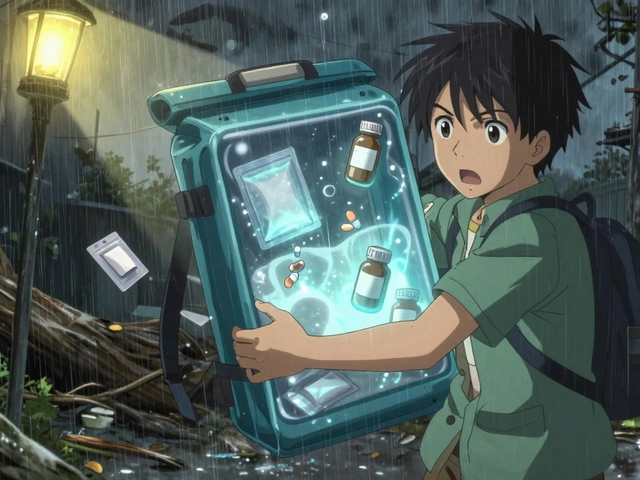
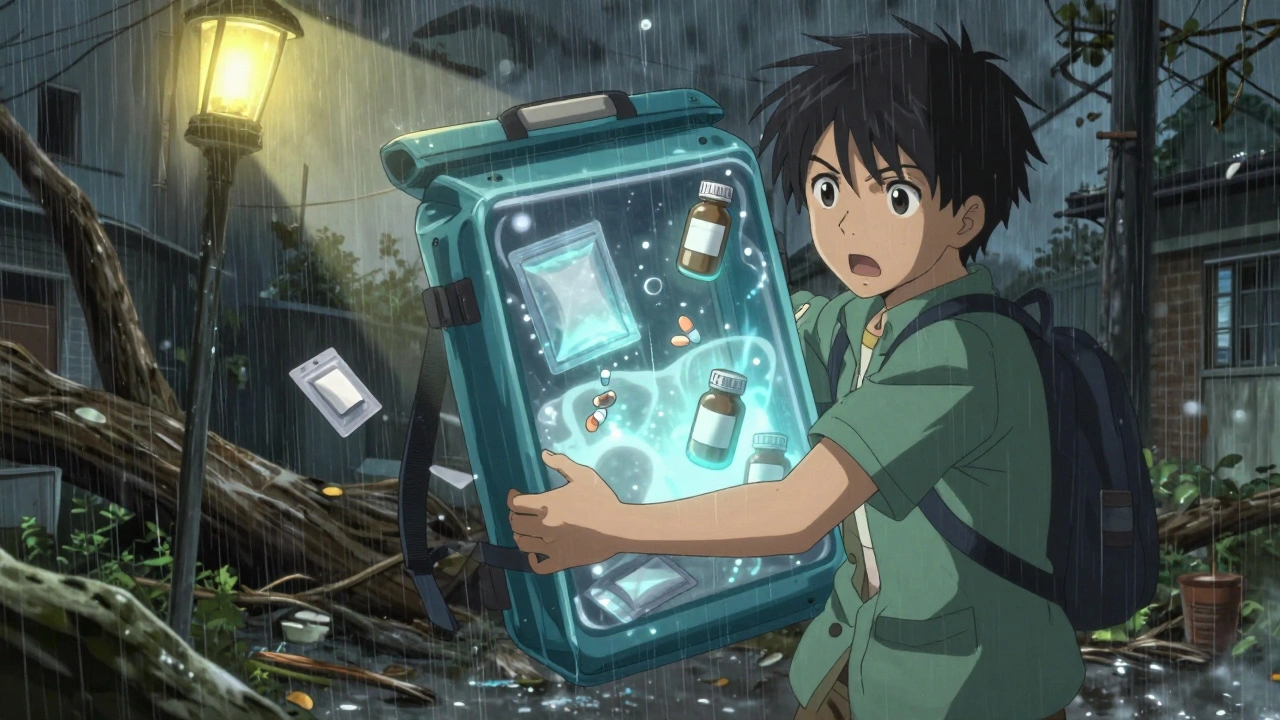
When a storm knocks out power for days or a wildfire forces you to evacuate, your emergency kit could mean the difference between life and death. But if your medications are degraded, expired, or ruined by heat and humidity, that kit is just a heavy backpack full of useless pills. Emergency medication storage isn’t about keeping a few extra prescriptions on hand-it’s about making sure those pills still work when you need them most.
Why Your Medications Die in the Emergency Kit
Most people assume if a pill is in a bottle and hasn’t passed its printed expiration date, it’s fine. That’s a dangerous assumption. The expiration date is only a guarantee under ideal conditions: cool, dry, dark, and stable. In a real emergency, your meds are likely sitting in a hot car, a damp basement, or a bathroom with steam rising from the shower. Studies show that improper storage causes most medication failures. The FDA found that temperature excursions are responsible for 78% of emergency medication failures they investigate. Epinephrine auto-injectors-critical for allergic reactions-can lose 37% of their potency in just 72 hours if exposed to temperatures above 77°F. Insulin, if left unrefrigerated for more than 12 hours above 46°F, loses 15% of its effectiveness. Acetaminophen tablets stored in high humidity (above 75%) show 28% slower dissolution, meaning they won’t absorb properly in your body. Bathrooms are the worst place for meds. A 2022 study by the American College of Emergency Physicians found that medications stored in bathrooms degrade 40% faster than those kept in kitchen cabinets. Humidity from showers and sinks breaks down tablet coatings and causes pills to stick together or crumble. Even if the bottle looks fine, the active ingredient may already be gone.What You Need to Store Medications Properly
There are three non-negotiable rules for keeping emergency meds effective: temperature, humidity, and light.- Temperature: Most pills and capsules should be kept between 59°F and 77°F (15°C-25°C). That’s room temperature in a typical home. Refrigerated meds like insulin, some antibiotics, and liquid suspensions need 36°F-46°F (2°C-8°C). Never freeze medications unless the label says it’s safe.
- Humidity: Keep relative humidity below 60%. Moisture causes tablets to break down, capsules to soften, and powders to clump. Silica gel packets (the little white packets you find in new shoes or electronics) help absorb moisture. Keep them in your kit.
- Light: Direct sunlight destroys active ingredients. Amoxicillin capsules exposed to direct sun for 48 hours lost 42% of their potency. Store everything in opaque containers or inside a closed box.
Use the Right Containers
Never transfer pills from their original bottles into plastic bags, Ziplocs, or random containers. The FDA says 33% more medication integrity is lost when drugs are moved from original packaging. Why? Original bottles are designed to block light, resist moisture, and have child-resistant caps. They also have the National Drug Code (NDC) on the label-critical for emergency responders to identify what you’re taking. For long-term storage, vacuum sealing solid medications (pills, capsules, tablets) can extend shelf life by 1-2 years beyond the printed date. Research from Intermountain Healthcare shows vacuum-sealed meds retain 95% efficacy for 24 months past expiration, compared to just 68% for non-vacuum sealed. Use a food-grade vacuum sealer with heat-sealable mylar bags. Avoid using plastic wrap or aluminum foil-these don’t create a true vacuum and can trap moisture. For liquids, insulin, and injectables, vacuum sealing won’t help. Instead, use insulated medical coolers with ice packs rated for 72+ hours. The American Diabetes Association recommends carrying at least a 48-hour supply of insulin in a portable cooler during any potential evacuation. Battery-powered medical coolers are worth the investment-they maintain steady temperatures even during multi-day outages.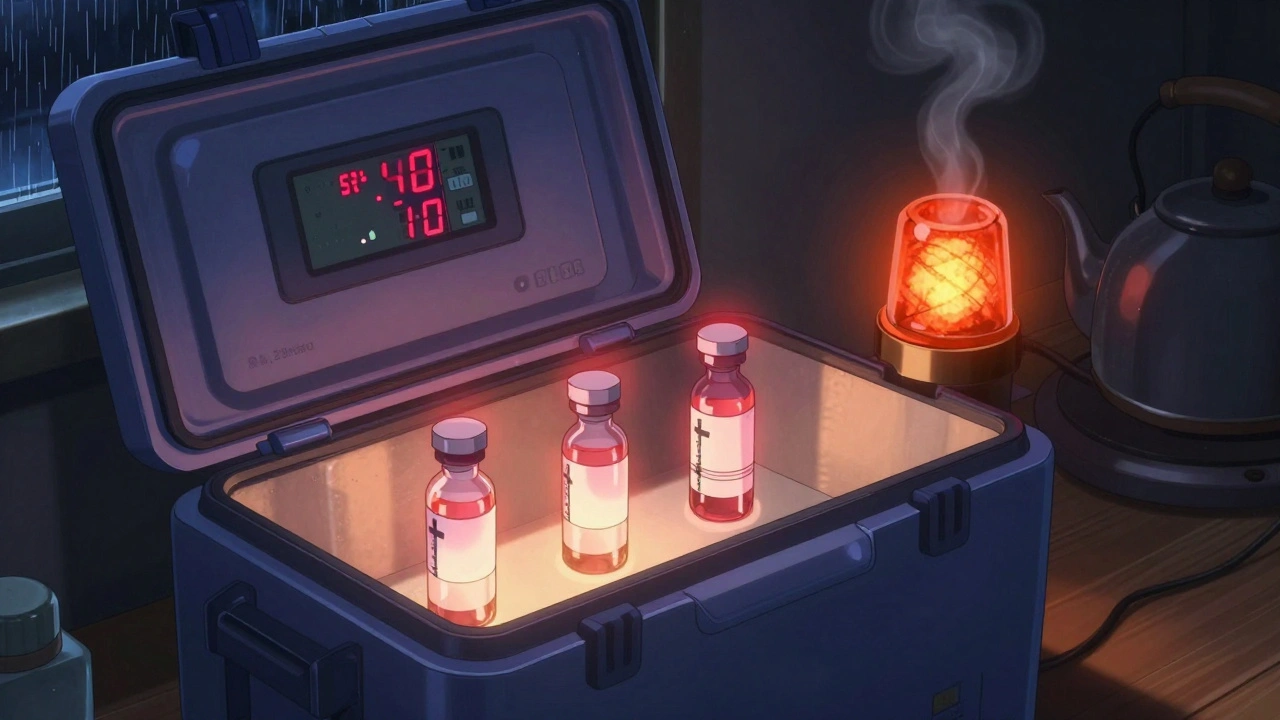
Temperature Monitoring Is Non-Negotiable
You can’t guess if your meds are safe. You need proof. The ANSI/AAMI ST79:2017 standard requires temperature monitoring devices with ±0.5°F accuracy in emergency kits. That means no cheap digital thermometers from the hardware store. Use a digital data logger that records temperature over time. Some models connect to your phone via Bluetooth and send alerts if temps go out of range. Amazon reviews show products with this feature get 4.6/5 stars, while those without average 3.2/5. The top complaint in negative reviews? “No idea if my meds got too hot.” Keep a log. During an emergency, record temperature twice a day-morning and night. Note the time, reading, and any power outages. This isn’t just for you-it helps paramedics or doctors understand if your meds might have failed.What to Include in Your Kit
Your emergency medication kit should have at least a 30-day supply of all your regular prescriptions, not just the 3-day minimum some outdated guides suggest. Dr. Michael Rhodes of Intermountain Healthcare says: “Three days is the absolute minimum, but 30 days is what truly constitutes preparedness for most disasters.” Here’s what to pack:- All prescription medications (including refills)
- Over-the-counter essentials: pain relievers, antihistamines, antacids, laxatives
- Epinephrine auto-injectors (replace every 12-18 months regardless of expiration date-they lose 15% potency per year even in perfect storage)
- Insulin and other refrigerated meds with a battery-powered cooler
- Medical devices: glucose meters, inhalers, nebulizers with extra batteries
- Prescription copies and a list of allergies and conditions
Special Cases: Insulin, Epinephrine, and Liquid Meds
Insulin is the most fragile. Even with refrigeration, it loses potency over time. The FDA approved Tresiba® in January 2023-the first insulin stable at room temperature (up to 86°F) for 56 days. That’s a game-changer. If you’re on insulin, ask your doctor if you can switch to a temperature-stable version. Epinephrine auto-injectors are another critical item. They’re not like pills. The active ingredient degrades faster, even in perfect conditions. Replace them every 12-18 months. Don’t wait for the expiration date. If you’ve used one in an emergency, replace it immediately-even if it’s not expired. Liquid medications (suspensions, eye drops, injectables) are the hardest to store long-term. Even under ideal conditions, they only last 30-60 days past expiration. Don’t stockpile them unless you’re sure you’ll use them soon. Rotate them frequently.
Common Mistakes (And How to Avoid Them)
- Storing meds in the bathroom. Too humid. Use a bedroom closet or kitchen cabinet instead.
- Keeping meds in the car. Temperatures can hit 140°F in summer. Even in winter, freezing can ruin some meds.
- Ignoring humidity. Add silica gel packets. Don’t rely on the bottle alone.
- Not labeling. If you’re evacuating with a stranger’s kit, responders need to know what’s inside. Use clear labels with names, doses, and instructions.
- Forgetting children’s meds. Pediatric doses change fast. Include a current list of weights and allergies.
Real Stories, Real Lessons
On Reddit’s r/Preppers, users shared their experiences. One person, u/SurvivalMedic99, said their vacuum-sealed amoxicillin from 2019 worked perfectly during a 2022 emergency. Another, u/DiabetesPrepper, lost effectiveness in their insulin after 48 hours without refrigeration during a winter storm. They now carry a battery-powered cooler everywhere. The American Red Cross surveyed disaster survivors in 2022. Those who stored meds properly reported 73% no issues with effectiveness. Those who didn’t? Only 38% said their meds worked.What’s Changing in 2025
The landscape is shifting. The Department of Homeland Security now recommends a 14-day minimum supply for every household-double the old 7-day rule. Forty-eight U.S. states now require schools and daycare centers to follow strict emergency medication protocols. New tech is helping. The FDA launched a blockchain pilot in April 2023 with 10 major drugmakers to track storage conditions in real time. The goal: cut waste by 30%. By 2027, the International Pharmaceutical Federation aims to have 50% of essential emergency medications available in room-temperature stable forms. You don’t need to wait for the future. Start now. Your life, or someone else’s, could depend on it.Can I still use expired medication in an emergency?
Some solid medications like pain relievers or antihistamines may retain potency for years past their expiration date if stored properly. But this isn’t guaranteed. Epinephrine, insulin, antibiotics, and liquid meds are risky after expiration. Never use expired epinephrine or insulin unless you have no other option-and even then, it may not work. When in doubt, replace them.
Is it safe to store medications in the fridge?
Only if the label says so. Most pills don’t need refrigeration. In fact, moisture from the fridge can damage them. Only refrigerate insulin, some antibiotics, eye drops, or liquid suspensions. Always keep them in sealed containers to prevent condensation. If you’re evacuating, use a portable medical cooler with ice packs instead of relying on a fridge.
What’s the best way to store emergency meds during a power outage?
For room-temperature meds, keep them in a cool, dark place like a basement or interior closet. For refrigerated meds, use a battery-powered medical cooler with ice packs rated for 72+ hours. If you don’t have one, the toilet tank method (placing sealed meds in a sealed bag in the tank) can keep things 15-20°F cooler than room air for 8-12 hours-but it’s not reliable long-term. Never use a regular cooler without ice packs-it won’t stay cold enough.
Should I vacuum seal all my emergency meds?
Only solid medications: pills, capsules, tablets. Vacuum sealing extends shelf life by 1-2 years. Do NOT vacuum seal liquids, insulin, creams, or injectables-it can damage them. Always keep original labels on the bottles before sealing. Use food-grade mylar bags and a heat-sealing vacuum sealer. Don’t use Ziploc bags-they don’t create a true vacuum.
How often should I check my emergency medication kit?
Check it every month. Set a calendar reminder. Look for changes in color, smell, texture, or if pills are sticking together. Replace anything that looks off. Rotate meds so the oldest are used first. Replace epinephrine auto-injectors every 12-18 months, even if the date hasn’t passed. Keep a log of replacements.
Are there any new medications that are more stable in emergencies?
Yes. In January 2023, the FDA approved Tresiba® insulin, which stays effective for 56 days at 86°F-four times longer than older versions. Meridian Medical Technologies also released a temperature-stable epinephrine auto-injector in 2022 that lasts 18 months at room temperature. These are game-changers. Ask your doctor if you can switch to one of these newer, more stable options.