
When you pick up a generic medication, you might think you're getting the same thing as the brand-name version-and for the most part, you are. The active ingredient? Identical. The strength? The same. The FDA requires it. But what you can't see, what's hidden in the pill, capsule, or liquid, is where things get tricky. Generic medications often contain completely different inactive ingredients than their brand-name counterparts. And for some people, those differences aren't just technical-they can cause real, uncomfortable, even dangerous reactions.
What Exactly Are Inactive Ingredients?
Inactive ingredients, also called excipients, are the stuff that holds the medicine together. They don’t treat your condition. But they do everything else: make the pill easy to swallow, help it dissolve at the right time, keep it from breaking apart in the bottle, or even give it a color or flavor. Think of them like the frame, paint, and insulation of a house. The house (the active drug) does the job, but without the frame, it wouldn’t stand. Without the insulation, it might get too hot or too cold.
Here’s the wild part: for many pills, more than half the weight isn’t even the medicine. Some formulations are over 99% inactive ingredients. That’s not a typo. You’re swallowing mostly fillers, binders, dyes, and preservatives. And while the FDA says these are safe for most people, they’re not the same across every version of the same drug.
Why Do Generic Drugs Have Different Inactive Ingredients?
Generic manufacturers don’t have to copy the brand-name pill’s recipe. They just have to prove that the active ingredient gets into your bloodstream at the same rate and amount. That’s bioequivalence. But once that’s done, they’re free to use whatever safe, approved filler they want. It’s cheaper, faster, and sometimes easier to source different ingredients from different suppliers.
So one company’s generic version of a blood pressure pill might use lactose as a binder. Another might use cornstarch. A third might use a dye that contains FD&C Red No. 40. All are FDA-approved. All are technically safe. But if you’re allergic to lactose, sensitive to artificial dyes, or have celiac disease, that difference matters.
Common Problematic Inactive Ingredients
Not all fillers are created equal. Some are harmless to nearly everyone. Others can trigger reactions in people who don’t even know they’re sensitive.
- Lactose - Found in over 20% of oral medications. If you’re lactose intolerant, this can cause bloating, cramps, and diarrhea.
- Gluten - Sometimes used as a binder. Even trace amounts can cause damage in people with celiac disease.
- FD&C dyes - Red No. 40, Yellow No. 5, Blue No. 1. Linked to skin rashes, migraines, and hyperactivity in sensitive individuals.
- Bisulfites - Used as preservatives. Can trigger asthma attacks in people with severe allergies.
- FODMAP sugars - Like sorbitol and mannitol. These ferment in the gut and can wreck havoc for people with IBS. About 55% of medications contain them.
- Peanut oil - Rare, but used in some liquid medications. Manufacturers are required to label this. Most other allergens? Not so much.
And here’s the kicker: there’s no federal rule forcing manufacturers to list all these on the packaging. You can’t just glance at the bottle and know. You have to dig into the manufacturer’s product insert or call the pharmacy.
Real People, Real Reactions
It’s not just theory. Patients are reporting problems.
One woman on a pharmacy subreddit shared that after switching from brand-name Synthroid to a generic levothyroxine, she developed severe stomach cramps and nausea. The symptoms vanished when she switched back. Another man with asthma noticed his breathing worsened after his pharmacist switched his generic blood pressure pill to a new version. His doctor didn’t know why-until he checked the inactive ingredients. The new version contained sodium metabisulfite, a known asthma trigger.
A 2022 survey by MedShadow found that 27% of people who switched to generics reported new side effects. Of those, 68% blamed the inactive ingredients. The FDA’s own adverse event database has hundreds of reports linking reactions to fillers in generic drugs. But because most doctors don’t ask about them, and most pharmacists don’t routinely check, these cases go unnoticed.
What the FDA Says vs. What Patients Experience
The FDA insists generic drugs are just as safe and effective as brand-name ones. And for most people, they are. The agency requires manufacturers to meet strict standards for purity, strength, and dissolution. The variation in active ingredient levels between brand and generic is typically less than 4%-far below the 20% legal limit.
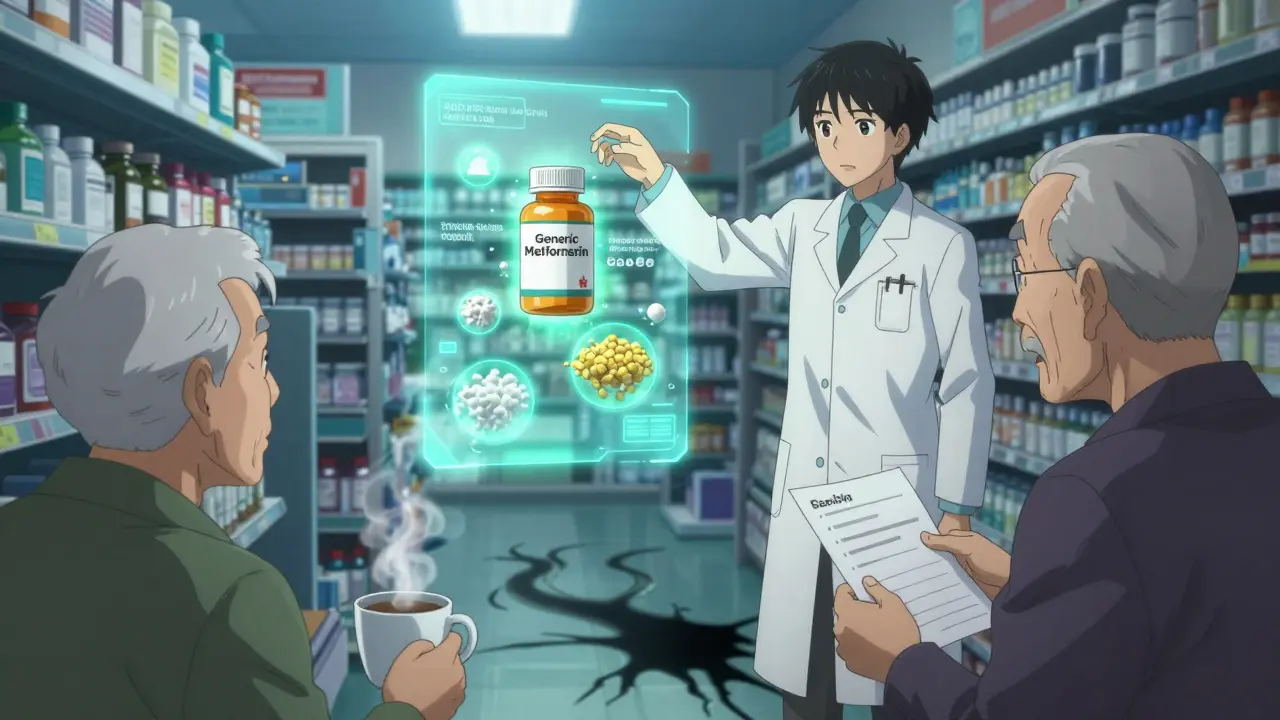
But here’s the gap: while the FDA tightly regulates the active ingredient, it doesn’t regulate the inactive ones the same way. There’s no requirement for consistency across manufacturers. No mandatory labeling of allergens beyond peanut oil. No public database that tells you, “This generic version of metformin contains cornstarch and titanium dioxide.”
Meanwhile, research from MIT and Brigham and Women’s Hospital found that nearly all medications contain ingredients that could trigger reactions in at least some people. And for patients on five or more medications-common for seniors-the risk of cumulative exposure to problematic fillers grows. One patient might be taking a generic statin with lactose, a blood pressure pill with dye, a diabetes med with sorbitol, a painkiller with gluten, and a multivitamin with sulfites. No single pill is dangerous. But together? It’s a storm.

What Should You Do?
You don’t need to avoid generics. They save money, and they work for most people. But if you’ve had unexplained side effects after switching, or if you have known allergies or intolerances, here’s what to do:
- Ask your pharmacist - Don’t assume all generics are the same. Ask: “Which manufacturer makes this version?” and “What are the inactive ingredients?”
- Check the manufacturer’s website - Most drug makers list full ingredient lists online. Search for “[Drug Name] + [Manufacturer] + inactive ingredients.”
- Compare labels - If you switch from one generic to another, keep the old bottle. Compare the ingredient lists side by side.
- Ask your doctor to specify “do not substitute” - If you’ve had a reaction before, your doctor can write a prescription that blocks automatic substitution.
- Use the FDA’s Inactive Ingredient Database - It’s not user-friendly, but it’s free. Search by drug name and see which fillers are approved. You can find out what’s in your pill, even if the label doesn’t say.
When to Stick With Brand-Name
There’s no shame in choosing the brand-name version if it’s the only one that works for you. Some medications-like levothyroxine, warfarin, and certain epilepsy drugs-are known to have more sensitivity to formulation changes. If you’ve tried generics and had side effects, and switching back to brand fixed it, you’re not imagining it. Talk to your doctor. Insurance often covers brand-name drugs if you can prove medical necessity.
And if you’re on multiple medications? Be extra careful. A 2020 study in PubMed Central found that patients taking five or more pills daily had a higher chance of being exposed to multiple problematic fillers. That’s not rare-it’s common. For seniors, it’s a hidden health risk.
The Bigger Picture
Generics saved the U.S. healthcare system hundreds of billions of dollars. They’re essential. But the system was built for efficiency, not individual sensitivity. Right now, the burden falls on the patient to spot the problem. Doctors don’t get trained on excipients. Pharmacists are rushed. Labels are vague.
Researchers at MIT are building a public database that maps inactive ingredients across every generic version of every drug. It’s still in development. But when it’s live, it could change everything. Imagine a smartphone app that scans your pill bottle and tells you, “This version contains lactose. You’re allergic. Try this alternative.”
Until then, knowledge is your best defense. Don’t assume all generics are equal. Don’t ignore new symptoms after a switch. And don’t let cost be the only factor when your body is telling you something’s off.
Are generic medications less effective than brand-name ones?
No, not in terms of the active ingredient. The FDA requires generics to deliver the same amount of medicine into your bloodstream as the brand-name version, within a very tight range. For 9 out of 10 people, the effectiveness is identical. But if you have allergies or sensitivities to inactive ingredients, you might feel worse-because your body is reacting to the filler, not because the medicine isn’t working.
Can I tell if a generic drug has different inactive ingredients just by looking at it?
Not reliably. Pills from different manufacturers might look different-color, shape, size-but that doesn’t tell you what’s inside. A white pill from one company might have lactose; a yellow one from another might have the same active ingredient but use cornstarch and dye. You need to check the manufacturer’s ingredient list or ask your pharmacist.
Do all generic manufacturers use the same fillers?
Absolutely not. Each manufacturer chooses its own formulation. One company might use magnesium stearate; another might use talc. One might use a gluten-free binder; another might not. There’s no standard. That’s why switching between generic brands-even for the same drug-can cause side effects.
Why don’t drug labels list all inactive ingredients clearly?
The FDA only requires labeling of major allergens like peanut oil. For everything else-lactose, gluten, dyes, FODMAP sugars-manufacturers aren’t required to highlight them on the bottle. The full list is usually in the package insert or on the manufacturer’s website, but most patients never see it. This lack of transparency is a major concern for patient advocates and researchers.
What should I do if I think my generic medication is causing side effects?
First, don’t stop taking it without talking to your doctor. Then, contact your pharmacist and ask what manufacturer made your current pill. Ask for the inactive ingredient list. Compare it to your previous version. If you find a change, talk to your doctor about switching back or trying a different generic. You can also report your reaction to the FDA’s MedWatch system-it helps track these issues.